



01. Recognize the consumer, not just the device
Ketch identifies consumers across browsers, devices, and channels using deterministic identity, so the opt-out they made on desktop is already honored when they open the app.
A cookie banner can't honor a Do Not Sell request. Ketch connects your form, CMP, and downstream systems, and follows the consumer across every device.
Fall 2026 Leader
Rated 4.6/5 on G2
Ketch is a Leader in the Gartner® Magic Quadrant™ for Privacy UX 2026
170+ verified reviews from privacy, security, and marketing teams.
Read Customer StoriesWe went from project start to go-live in three weeks. Few vendors match Ketch on time-to-value
$2.75M
Disney, California AG, streaming media: Opt-outs honored on one device or service while data sales continued on others
$530K
Sling TV, California AG, streaming TV: Privacy link routed consumers to cookie settings instead of a genuine sale or share opt-out
$632K
Honda, CPPA, automotive: Tags and pixels kept firing after consumers opted out
Product tour
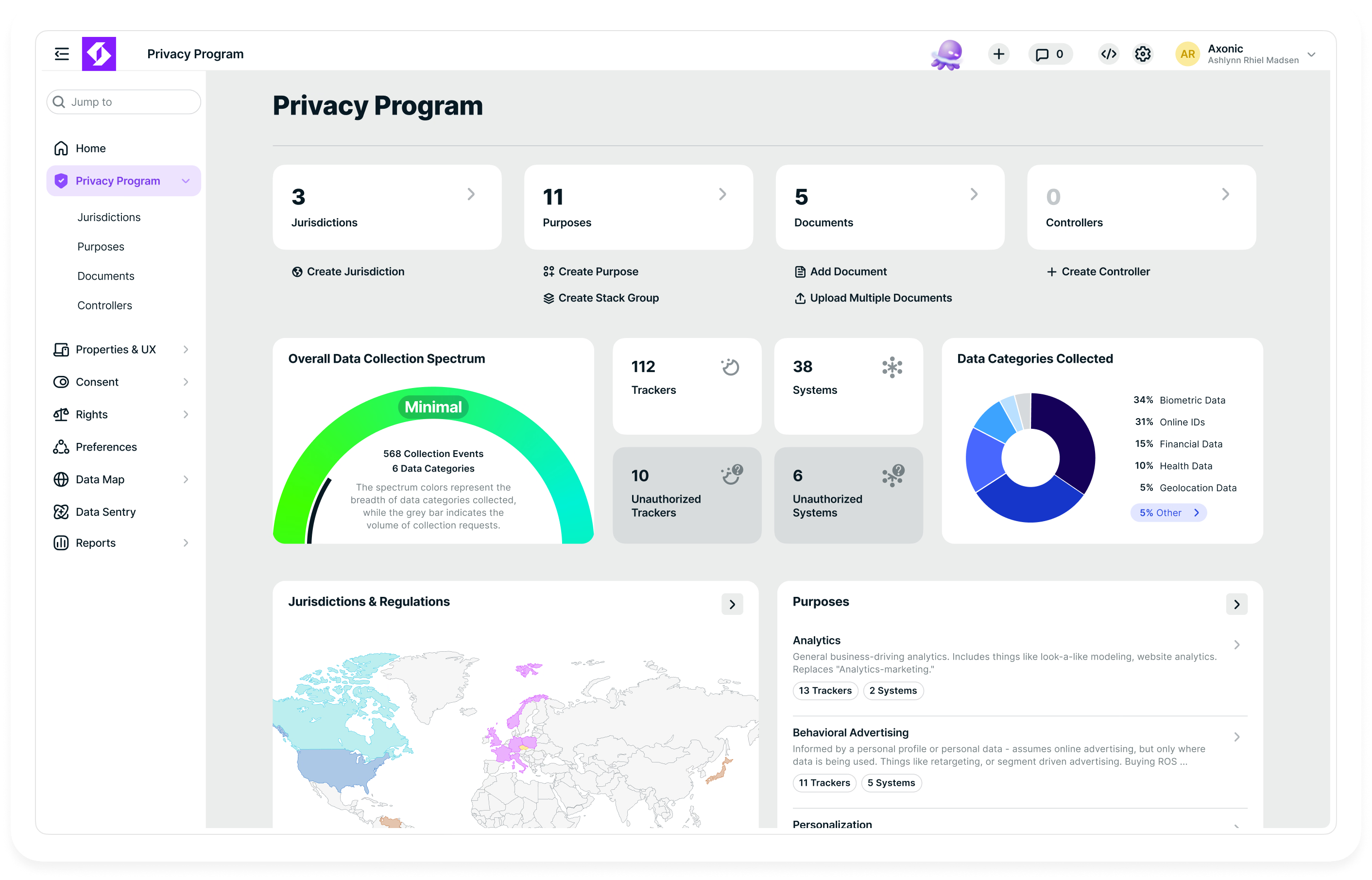
See how one consumer action updates the CMP, stops tags, and reaches downstream systems across devices.
How it works
Opt-Out Sync, built on the Ketch Identity Sync framework, connects your form, CMP, identity resolution, and downstream enforcement into one workflow. Here is what happens behind a single consumer action.
Ketch identifies consumers across browsers, devices, and channels using deterministic identity, so the opt-out they made on desktop is already honored when they open the app.
The form lives on your domain. One submission updates the CMP, stops the tags, and triggers downstream orchestration simultaneously. No second step for the consumer. No manual configuration for your team.
Ketch makes server-to-server API calls to downstream systems, ad platforms, CDPs, and marketing tools, and updates how that consumer's data is processed directly within them. Not a request. A change.
Two surfaces, one opt-out
A banner alone isn't enough to comply with DNS. It doesn't record an email address, so it can't reach offline data or downstream systems. A form alone can't do it either, without connecting back to the CMP, tags keep firing after the consumer opts out. The CCPA requires opt-outs cover both online and offline data. That means you need both, and they need to work as one. Ketch is the only platform where a single consumer action triggers the form, updates the CMP, and reaches downstream systems simultaneously.
Beyond a banner click
Capabilities that turn a single consumer action into honored opt-outs across devices, channels, and activation systems.
A consumer never has to repeat themselves. One submission is automatically applied across systems, with identity signals that recognize the consumer across logged-in and logged-out states, browsers, and devices.
When Ketch already has a reliable identifier, the experience skips redundant requests for information such as email addresses. When the consumer is unknown, the opt-out still goes through without additional data collection.
A single opt-out process governs enforcement for anonymous and authenticated consumers, so opt-out logic never diverges based on how someone interacts with your business.
Backend workflows recognize an opt-out expressed through the banner, and an opt-out submitted through the webform is reflected in consent enforcement on the site, with no manual reconciliation and no ambiguity about which signal wins.
Once captured, the opt-out propagates across browser configurations, backend systems, and downstream partners, including CRM platforms, CDPs, advertising systems, identity resolution providers, and DSPs, and every enforcement action is logged with an identity-based audit trail.
Failure modes
Six failure modes appear across nearly every enforcement action, each paired with the Ketch capability that closes it.
Honda failed to stop certain tags and pixels from firing after consumers opted out. Data Sentry monitors live network traffic to verify the opt-out actually stops the tag, not just the prompt.
Sling TV routed consumers to cookie settings instead of a genuine sale or share opt-out. Ketch Consent Management and DSR Automation are natively connected, so a single submission via either surface covers both.
Disney honored opt-outs on one device or service while data kept flowing on others. Identity synchronization carries the opt-out across devices, browsers, and authenticated sessions.
Client-side consent tools stop at browser tags. Ketch pushes opt-out state into server-side ad calls, CDP audiences, and CRM records.
State laws differ on what an opt-out covers. Policy templates route CCPA, CPRA, and the Do Not Sell laws that followed in Colorado, Virginia, Texas, and Montana without splitting configuration.
Regulators expect proof, not policy claims. Permission Vault retains the signal, the timestamp, and the downstream propagation path for every choice.
Regulatory proof
Settlement records make the cost of failure concrete: Disney ($2.75M, streaming media), Healthline ($1.55M, media), Honda ($632K, automotive), Sling TV ($530K, streaming TV), and Todd Snyder ($345K, retail) all turned on whether opt-outs worked in practice. Ketch turns opt-out compliance into testable, defensible workflows instead of policy claims.
Check whether your systems honor privacy choices after opt-out, using the same network-level evidence plaintiffs and regulators use.
Produce the authoritative record of a consumer's consent and rights state: when the choice was made, which systems received it, and what changed as a result.
Detect unauthorized post-opt-out transfers with Data Sentry before a regulator or a demand letter does.
ROI
12x
ROI vs. legacy, cookie-based privacy tools.
+95%
Productivity gain vs. manual DSR workflows.
+70%
Productivity gain vs. survey-based data discovery.
Integrations
Ketch ships connectors and SDKs so consent, rights, and policy flow into your CDPs, warehouses, ad platforms, and AI stack without a custom data pipeline.
Related reading
Ketch has you covered.
Get started in less than 5 min