




Summarize this article with
Hundreds of brands receive CIPA demand letters every week, alleging that standard website tracking tools constitute illegal wiretapping under California law. CCPA compliance won't protect you, and settling once doesn't stop the next letter. This guide covers what the letter means, how to assess it, and what audit-ready consent infrastructure you need to defend your brand confidently.
If you work in privacy, legal, or marketing at a brand with a digital presence, there's a reasonable chance you’ve already received a CIPA (California Invasion of Privacy Act) demand letter.
Online tracking lawsuits skyrocketed from roughly 200 cases in 2023 to nearly 4,000 in 2024, with demand letters and arbitration filings stacking on top of that. More than 70% of those claims are coming from just four law firms operating a volume-based model designed to turn mass mailings into mass settlements.
The instinct when one arrives is to panic. The letter looks serious, the deadline is real, and the damages figures cited – $5,000 per violation or three times actual damages, whichever is greater, with no requirement to prove actual harm – can run into the millions on paper. But the first thing worth understanding is that these letters are not all created equal, and many of them don't hold up to scrutiny.
"The allegations are often sloppy," says Alysa Hutnik, partner at Kelley Drye. "These firms are going for breadth, not accuracy. What you're really doing is risk mitigation; making sure you've cleaned up the collection errors that make cases expensive."
That's exactly the right frame. This may be a legal problem, but the solution is technical. As Ketch's DPO and Corporate Counsel, I want to walk through what we're seeing, what actually matters when a letter arrives, and what brands can put in place so they're never starting from zero when one does.
Disclaimer: This article is provided for general informational and educational purposes only and does not constitute legal advice. Nothing in this post should be relied upon as a substitute for advice from qualified legal counsel licensed in your jurisdiction, and reading it does not create an attorney-client relationship with Ketch, its affiliates, or any contributor quoted herein. CIPA case law is unsettled and changing rapidly; outcomes turn on specific facts, courts, and timing. If you have received a demand letter or are evaluating your exposure, consult experienced privacy counsel before taking action.
CIPA demand letters, explained
CIPA is a 1967 California wiretapping statute, written long before the internet existed. In recent years, plaintiffs' attorneys have reinterpreted it to apply to website tracking technologies — pixels, cookies, session replay tools, chatbots, search bars, SDKs — arguing that these tools "intercept" user communications in real time, in the same way a wiretap intercepts a phone call.
For background on why these old wiretapping laws are increasingly targeting digital brands, read our deep-dive: Wiretapping Laws in the Digital Era.
What is a CIPA demand letter?
A CIPA demand letter is a pre-litigation notice claiming your website's tracking tools — pixels, cookies, or session replay software — illegally intercepted user communications under California's 1967 Invasion of Privacy Act. It demands a settlement, typically within 30 days, and cites $5,000 in statutory damages per violation.
The statute provides $5,000 in statutory damages per violation, with no need for plaintiffs to prove actual harm. That statutory damage structure is what makes CIPA so attractive to plaintiffs' firms and so alarming to brands receiving demand letters.
What does a CIPA demand letter contain?
A CIPA demand letter typically references who visited your website and when, which specific tracking tool is alleged to have fired and what it transmitted, the legal theory being invoked (usually California Penal Code Section 631(a) or Section 638.51), a damages calculation that can project thousands of violations, and a settlement demand with a deadline of 20 to 30 days. Which section the letter cites now matters more than it used to, because SB 690 would foreclose private § 638.51 claims while leaving § 631 fully intact.
The most important thing to understand immediately: CCPA compliance does not protect you here. CIPA and CCPA are separate statutes addressing different legal theories.
Being compliant with California's consumer privacy law does not immunize a brand from CIPA litigation. This distinction surprises many privacy and legal teams who assumed their consent management program covered them.
How to assess a CIPA demand letter
Not every demand letter is equal. Start your assessment with a few key steps:
- Evaluate the firm
- Read the technical allegation carefully
- Assess your standing exposure
Evaluate the firm
A small number of plaintiffs' firms are responsible for the overwhelming majority of CIPA demand letters.
These firms have developed highly industrialized operations: they scan websites in bulk using automated tools, look for any tracking pixel that fires before consent is captured, and generate templated letters.
Knowing whether the firm has a reputation for actually filing litigation, or primarily uses letters to extract nuisance settlements, affects your calculus significantly.
Read the technical allegation carefully
The letter will reference a specific tool — often the Meta Pixel, Google Analytics, TikTok Pixel, or a session replay product — and describe the behavior that triggered the claim.
What exactly was alleged to have been intercepted? Was it an IP address, a search term, a form entry, a page navigation? Courts are increasingly distinguishing between different types of data, and not all claims are equally strong.
Assess your standing exposure
The legal landscape around CIPA is genuinely in flux. Courts are reaching different conclusions on similar facts, and precisely how you respond is a question for legal counsel – not something any software vendor should be prescribing. What we can tell you is that the strength of your technical posture will directly shape the options your counsel has to work with.
Before you respond, determine what your website was actually doing
At a glance, it may seem that the path of least resistance is to quietly settle these letters. Write a check, move on, and hope the next one doesn’t arrive.
The problem with that approach isn't that settling is wrong. Sometimes it's the right call, and experienced privacy counsel will tell you that a negotiated settlement can be perfectly reasonable depending on the circumstances.
The real problem? Choosing to settle without knowing whether the claim is even credible.
These letters are generated at scale by a small number of firms using automated scanning tools. They are designed for volume, not precision, and the allegations are often sloppy and built on incomplete or outright incorrect readings of what your site was doing.
The brands that handle this well are the ones that can actually answer: did this happen? They can pull up their consent logs, run a scan of their tag behavior, and evaluate the technical claim on its merits before deciding how to respond. That changes everything: not because it guarantees a particular outcome, but because it turns a reactive scramble into an informed decision.
That's the posture worth building toward: not litigation readiness, but technical visibility and accuracy.

Run your Free Privacy Health Check Are hidden website trackers putting your brand at risk? Find out now. Check your compliance score →
Three things every brand needs before a CIPA demand letter arrives
I spoke with Max Anderson, our Co-founder and Head of Product, about what he's seeing across the brands we work with. His view is blunt: there is no silver bullet. But there are three concrete things that meaningfully change your ability to respond confidently to a demand letter claim.
1. Give clear notice, with a time delay before data collection starts
A central argument in many CIPA demand letters today is that presenting a notice to users at the same moment data collection begins doesn't give consumers enough time to read and understand what's happening.Plaintiffs' attorneys argue that isn't reasonable.
One practical response that we see some companies take is to create a time delay between notice and collection. Give the user a window to absorb what they're being told before tags start firing.
"The next move on the privacy tool side," says Max, "is to create some separation between when that notice is given and when the data collection starts happening. Imagine adding a ten or fifteen second delay or buffer between the data collection and the notice itself. As it stands today, that is one of the best things, if not the only thing, that you can do on the notice side."
This is a meaningful shift from how most brands think about consent banners. The banner existing isn't enough. The sequence and timing of what fires relative to when the user sees the notice is what plaintiffs' attorneys are scrutinizing, and getting that right requires more than a standard banner implementation.
2. Maintain auditable records of consent, down to the page and timestamp
If a plaintiffs' attorney makes a set of claims about your site's behavior, you need to be able to verify or refute those claims with actual evidence. Not a privacy policy. Not a general description of your consent setup. Timestamped, individual-level records of what fired, when, and what the user's consent state was at that moment.
"Sometimes these claims are just completely irrational," says Max. "Having a strong auditability framework in your privacy tool is certainly useful. You want to be able to prove that whatever claims they're making are or aren't true."
The technical cause underlying most CIPA demand letters is the same: a tracking tool allegedly fired before the user had an opportunity to consent. If you can produce a timestamped record showing that didn't happen, or that the user affirmatively consented, your position changes dramatically. If you can't produce that record, that's the gap that needs closing.
3. Use HAR files to fact-check claims before you respond
Most plaintiffs' attorneys build their cases around something called a HAR file, a detailed technical record of every network request a browser makes during a session on your site. It captures what fired, when, and what data was transmitted. That HAR file becomes their evidence.
"Sometimes they actually make mistakes in processing that information," Max notes. "So being able to process that HAR file yourself, graphically represent what was happening, and do a little fact-checking on the claims the plaintiffs' attorney is making, is very useful."
But the more important use of this capability is proactive. You don't have to wait for a demand letter to run this kind of scan. Doing it yourself first tells you exactly what a plaintiffs' attorney would see if they visited your site today: whether sensitive data is being transmitted to third parties, whether tags are firing in the right sequence, whether your notice setup holds up to scrutiny.
"You want to understand that before they come after you," Max says. "Check yourself first.”
How Ketch helps brands stay ahead of CIPA demand letters
Having the right technical foundation isn't just about being prepared for a demand letter. It's about being able to answer the question confidently when one arrives: did this actually happen? Here's how Ketch's products map to each of the three areas Max outlined.
Data Sentry: test your own site before they do
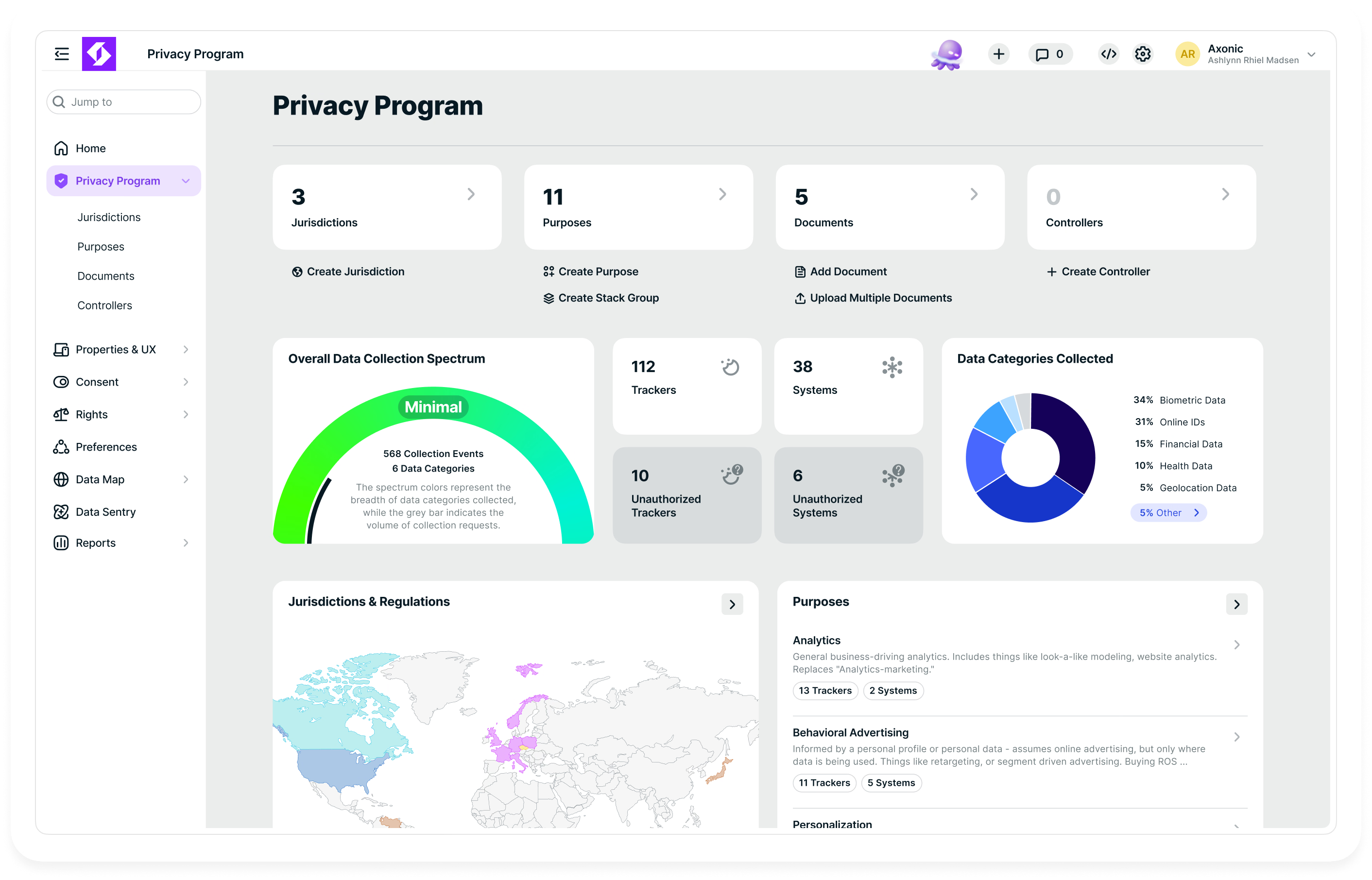
Data Sentry — know what's actually running on your site. Data Sentry is your privacy pentest. It continuously scans your live digital properties and shows you exactly what a plaintiff's attorney or regulator would see when they visit: which tags fired, which third-party domains received data, and whether any of that happened before a consent signal was captured.
Critically, Data Sentry can also process HAR files directly. If a demand letter arrives with technical claims about your site's behavior, you can upload the HAR file, graphically represent what was actually happening, and fact-check the allegation before you respond. That's not a capability most brands have, and it changes the dynamic considerably.
Not a point-in-time audit. A live, always-on map of your real data collection behavior, tuned to the exact technical patterns that generate CIPA demand letters.
Consent Management: separate your notice from your data collection
Consent management — pause first, fire second. Ketch Consent Management supports configurable time delay between notice presentation and data collection, directly addressing the timing argument at the center of most modern CIPA claims: that data collection begins before users have had reasonable opportunity to absorb what they're being told.
Consent banners are configurable without engineering, and consent signals propagate automatically to downstream systems through Ketch's native integrations, so the choice a user makes is honored consistently across every connected system.
Privacy 360 Analytics Suite
Privacy 360 Analytics Suite — your audit trail, automatically. The granular, identity-driven reporting available in Privacy 360 Analytics Suite captures the full lifecycle of every consent decision: timestamp, method, banner interaction, and every system that received and enforced the signal. When a plaintiffs' attorney makes a claim about what your site was doing at a specific moment for a specific visitor, Privacy 360 is how you pull up that record and answer the question with evidence rather than assertion.
This is what transforms a demand letter from a crisis into a manageable situation. Not just knowing your consent setup is correct, but being able to prove it, at the individual level, on demand.
The result isn't just a stronger legal position when letters arrive. It's a fundamentally different posture: instead of scrambling to reconstruct what happened after a claim lands, you have a continuous, living record of what your systems did and what your users chose.
That's what it looks like to confidently prove you're doing things right, not just saying it.
What SB 690 changes, and what it leaves in place
Legislative relief is now real, narrow, and not yet law.
California's SB 690 passed the Legislature on August 28, 2026 and awaits Governor Newsom's signature. He has until September 30, 2026 to sign it, veto it, or let it become law without a signature, and has taken no public position. Every recorded vote in both chambers, including a 66-0 Assembly vote, showed no opposition.
The bill that passed is much narrower than the one introduced in February 2025. The original version would have created a broad "commercial business purpose" exemption across CIPA's wiretapping, eavesdropping, recording, and pen register provisions. It passed the Senate unanimously in June 2025, stalled in the Assembly, and was rewritten on July 1, 2026 to drop the exemption entirely.
What survived does one thing: it amends Penal Code § 637.2 so that a claim under § 638.51, the pen register and trap-and-trace provision, arising from conduct on a website, online application, or mobile application, may be brought only by the California Attorney General. Private plaintiffs lose that one count. If signed, it takes effect January 1, 2027.
Two details matter more than the headline.
It reaches backward. The amendment applies retroactively to any pending claim in an action commenced within two years before the operative date, which reaches qualifying § 638.51 claims filed on or after January 1, 2025. Read the words "action commenced," though. A pre-suit demand letter is not an action commenced, so nothing in SB 690 extinguishes an unanswered demand letter by operation of law.
It leaves the more valuable claim alone. CIPA § 631, the wiretapping provision, is untouched and carries the same $5,000 per violation exposure. So are § 632, the federal Wiretap Act, the VPPA, common law claims, and the wiretap statutes in Florida, Pennsylvania, Arizona, and Washington that plaintiffs' firms have been developing in parallel. A complaint resting only on § 638.51 may become dismissible. A complaint pleading § 638.51 as one count among several will not go away.
The practical effect is a change in which claim you face rather than an end to the exposure. A § 638.51 theory alleges that a technology captured routing and addressing data, which is straightforward to plead from an automated page scan. A § 631 theory alleges that a third party read the contents of a communication in transit, meaning what a person typed, searched, submitted, or watched. That takes more work per case on a claim worth the same amount, so expect filing volume to fall and the surviving claims to turn on evidence about payloads rather than evidence about tags.
Meanwhile, the case law is fracturing in ways that make outcomes difficult to predict:
- Some courts are dismissing CIPA claims for lack of standing.
- Others are allowing them to proceed, and in some instances certifying class actions, where the tracking technologies involved are argued to intercept or read user communications in real time.
- Courts in the same district are reaching opposite conclusions on identical facts.
For brands, this uncertainty reinforces the same point we've been making throughout: the most reliable position is a proactive one. Know what's running on your site, have consent records that hold up, and be able to demonstrate both before a letter arrives rather than after.
The short version: what to do if you got a demand letter
If you just received a letter, a few immediate steps matter:
- Don't ignore it. The deadline is real and non-response typically strengthens the other side's position.
- Check what your site was actually doing. Pull your consent logs, run a scan, and evaluate whether the technical claim is even credible before deciding how to respond.
- Work with privacy-specialized legal counsel on strategy. CIPA litigation is technical and fast-moving, and how you respond is a decision that benefits from experienced guidance.
But the real leverage? What you have in place before the letters arrive. The brands that handle demand letters well aren't scrambling to reconstruct what happened after the fact. Here's what that foundation looks like:
- Clear notice, with a time delay before data collection starts. Present your notice first and give users reasonable time to absorb it before any tags fire.
- Audit logs that document consent at the individual level. Timestamped records of what fired, when, and what the user's consent state was at that moment. Privacy 360 is that infrastructure.
- Continuous scanning of your own digital properties. Know what's running on your site, including tools your own team didn't put there, before a plaintiffs' attorney finds them first. Data Sentry can tell you in real time.
- HAR file processing capability. Be able to read the same evidence they're building their case from, and fact-check it yourself.
The bottom line
CIPA demand letters are not going away. The firms sending them have a working business model, the legislative fix reaches one count out of several, and the case law is fractured enough to keep the threat alive regardless of how any individual court rules.
The brands that come out ahead are the ones that stop treating this as purely a legal problem. The technical foundation – notice timing, auditability, continuous scanning – is what gives you something to stand on when a letter arrives. Build it before you need it.
See what's actually running on your site: Talk to a Ketch privacy expert →


