



Summarize this article with
What is GDPR compliance?
GDPR compliance means following the requirements of the General Data Protection Regulation, an EU law that governs how personal data of EU citizens is collected and processed. It includes actions like gaining clear consent, restricting data use to specific purposes, and giving individuals control over their personal information.
Core principles of GDPR compliance
To meet the requirements of the General Data Protection Regulation, organizations must follow several foundational principles that govern how personal data is handled:
- Lawful, fair, and transparent processing: Organizations must process personal data with a valid legal basis, be clear about how it’s used, and treat it ethically
- Purpose limitation: Collect data for clearly defined, legitimate reasons and avoid using it for unrelated purposes
- Data minimization: Limit data collection and processing to only what is necessary for the intended purpose
- Accuracy: Ensure personal data is correct, complete, and updated as needed
- Storage limitation: Retain data only as long as necessary, and securely delete it when it’s no longer required
- Security and confidentiality: Implement safeguards to protect data from unauthorized access, loss, or misuse
- Accountability: Organizations must take responsibility for GDPR compliance and be able to demonstrate it
- Explicit consent: Consent must be clearly and freely given, specific, informed, and unambiguous—never assumed
- Individual rights: Individuals have the right to access, correct, delete, restrict, and transfer their personal data
- Breach notification: Data breaches must be reported to authorities—and in some cases, to affected individuals—within 72 hours
- Data Protection Officer (DPO): Certain organizations must designate a DPO to oversee and ensure compliance with data protection obligations
- Privacy policy: Websites and services must provide a clear, accessible policy outlining their data practices
Consequences of non-compliance with GDPR
Failing to comply with the General Data Protection Regulation can lead to severe penalties, including fines of up to €20 million or 4% of a company’s annual global revenue—whichever amount is higher. These consequences underscore the importance of adhering to GDPR requirements to avoid financial and reputational harm.
Now that's we've briefly addressed GDPR compliance, let's take a look at the EU privacy law further.
Key definitions in GDPR
The General Data Protection Regulation (GDPR) introduces several key definitions that establish the framework for data protection and processing across the European Union.
Understanding these definitions is crucial for businesses and individuals to ensure compliance and uphold data privacy rights. These terms are explicitly defined in Article 4 of the GDPR.
- Data subject: Defined in Article 4(1), a data subject is any identifiable natural person whose personal data is processed by a controller or processor. This includes customers, employees, and any individual interacting with a business.
- Personal data: Under Article 4(1), personal data refers to any information related to an identified or identifiable natural person. This includes direct identifiers such as names and email addresses, as well as indirect identifiers like IP addresses and biometric data.
- Data controller: As described in Article 4(7), a data controller is the entity that determines the purposes and means of processing personal data. Controllers bear primary responsibility for ensuring GDPR compliance.
- Data processor: Mentioned in Article 4(8), a data processor is an entity that processes personal data on behalf of the controller, following their instructions. Processors must adhere to strict security and compliance obligations.
- Consent: Defined in Article 4(11), consent must be freely given, specific, informed, and unambiguous. It requires a clear affirmative action from the data subject, ensuring they fully understand what they are agreeing to.
Who must comply with GDPR?
Don’t assume you’re safe just because you’re based outside the EU. The General Data Protection Regulation (GDPR) applies to a broad range of organizations, regardless of their location, if they process the personal data of individuals within the European Union.
Any company with a physical presence in Europe will almost certainly be subject to the GDPR. Even a company that doesn’t collect data about customers will likely collect data about its employees, and thus need to comply with the GDPR.
But the GDPR also applies to companies serving European customers, even if the business itself is based elsewhere. If you ship your products to a customer in Belgium, for instance, you’ll need to handle that customer’s data in GDPR-compliant ways.
And don’t assume that you’re safe just because you aren’t selling into European markets. If your digital services or websites are accessible from Europe, you’re likely collecting data about Europeans who browse your online offerings. That alone is enough to trigger the GDPR, even if you never receive a single euro from those digital visitors.
Read more: The top 5 GDPR compliance mistakes and how to avoid them
The scope of compliance is outlined in Article 2 and Article 3 of the GDPR, which define its material and territorial applicability.
- Organizations established in the EU: Under Article 3(1), any organization operating within the EU, regardless of where data processing takes place, must comply with GDPR when processing personal data.
- Organizations outside the EU processing EU data: According to Article 3(2), GDPR applies to non-EU organizations if they offer goods or services to, or monitor the behavior of, individuals in the EU. This includes businesses with websites accessible in the EU or using tracking technologies like cookies.
- Data controllers and processors: As per Article 2(1), the regulation applies to both data controllers (who determine the purpose and means of processing) and data processors (who process data on behalf of controllers), ensuring accountability across the data processing chain.
- Public and private sector organizations: GDPR applies to businesses of all sizes, government agencies, nonprofits, and any entity handling EU personal data, with certain exemptions for purely personal or household activities under Article 2(2)(c).
- Third-party service providers: Companies providing services such as cloud storage, analytics, and marketing that involve EU personal data must also comply, even if their operations are outside the EU.
“The new rules will give citizens back control over their personal data and create a high, uniform level of data protection across the EU that is fit for the digital age and will stimulate growth, innovation, and job creation. The regulation will also apply to non-European companies offering services in the EU.”
- Věra Jourová, former European Commissioner for Justice, Consumers and Gender Equality
GDPR exemptions
The GDPR includes several exemptions where its rules do not apply, primarily outlined in Article 2(2) and other related sections of the regulation. These exemptions are designed to balance privacy rights with practical considerations for certain types of data processing activities:
- Personal or household use: Processing for purely personal activities, like social media use, is exempt.
- Law enforcement and national security: Activities related to crime prevention and national defense are excluded.
- Anonymous data: Truly anonymized data that cannot identify individuals is not covered.
- Journalism, research, and arts: Certain activities for freedom of expression may have exemptions.
- Non-EU businesses: Organizations outside the EU that don’t target or monitor EU residents are not subject to GDPR.
- Limited compliance for SMEs: Some obligations are lighter for small businesses if data processing is low risk.
These exemptions help balance privacy with practical needs across different sectors.
The bottom line: no matter where you’re based, and no matter the size or nature of your business, if you collect any data pertaining to a person based in the European Union—from a customer’s phone number to a website visitor’s IP address—then you need to pay attention to the GDPR.
Read further: Who does GDPR apply to?
Key provisions of GDPR
The key provisions of the General Data Protection Regulation (GDPR) establish comprehensive guidelines for the protection and processing of personal data. Some of the most important provisions include:
Lawful processing (Article 6)
Organizations must have a valid legal basis for processing personal data, such as consent, contractual necessity, or legitimate interest.
Consent (Article 7)
Consent must be freely given, specific, informed, and unambiguous, with clear opt-in mechanisms and the ability to withdraw consent easily.
Is GDPR opt-in or opt-out?
GDPR requires an opt-in approach for processing personal data based on consent. Individuals must give clear, informed, and affirmative consent before their data is collected or used. They also have the right to withdraw consent at any time. Unlike opt-out models, GDPR ensures users are in control from the start, promoting transparency and accountability.
Data subject rights (Articles 12-22)
The GDPR can seem complicated. In practice, though, the 88-page regulation has a straightforward goal: to secure eight key rights for people whose personal data is collected or used by businesses and other organizations:
- Right to access (Article 15): Individuals can request access to their personal data.
- Right to rectification (Article 16): Individuals can have inaccurate data corrected.
- Right to erasure ("right to be forgotten") (Article 17): Individuals can request deletion of their data.
- Right to data portability (Article 20): Individuals can request their data in a portable format.
- Right to object (Article 21): Individuals can object to processing for marketing or legitimate interests.
Read more: GDPR data subject rights
While the eight key rights are themselves fairly easy to understand, they add a critical new layer of complexity to the operations of virtually any organization that collects or uses personal data. To comply with the GDPR, it isn’t enough to simply request consent before collecting data: you need to treat consent as a living document that can be retracted or amended at any time, and you need to put systems in place to track a user’s data across your entire data ecosystem.
You need to ensure you don’t use data in ways for which users haven’t given ongoing consent, and you need to ensure that any vendors or outside partners that handle your data are also able to rapidly adapt to changes in user consent, and to provide the tracking and reporting that’s required under the GDPR.
Accountability and governance (Articles 24-30)
Organizations must implement measures to demonstrate compliance, such as data protection policies, staff training, and maintaining records of processing activities.
Data protection by design and by default (Article 25)
Organizations must incorporate data protection principles into the design of their processes, products, and services.
Data breach notification (Articles 33-34)
Organizations must notify supervisory authorities within 72 hours of discovering a personal data breach and inform affected individuals if there is a high risk to their rights and freedoms.
Data protection impact assessments (DPIAs) (Article 35)
High-risk data processing activities require a prior impact assessment to identify and mitigate risks.
Read more: Data Protection Impact Assessment (DPIA) Explained
Designation of data protection officers (DPOs) (Articles 37-39)
Under GDPR, certain organizations, such as public bodies or those processing large-scale sensitive data, must appoint a DPO to oversee compliance.
Cross-border data transfers (Articles 44-50)
Data transferred outside the EU must ensure adequate protection through mechanisms like standard contractual clauses (SCCs) or adequacy decisions.
GDPR requirements for businesses
Businesses subject to GDPR must comply with key requirements, including:
- Lawful processing: Data must be processed under a valid legal basis, such as consent or contract (Article 6).
- Consent: Must be freely given, informed, and easily withdrawn (Articles 7-8).
- Transparency: Clear privacy notices must inform individuals how their data is used (Articles 12-14).
- Data subject rights: Businesses must honor rights to access, correction, deletion, and objection (Articles 15-21).
- Security measures: Adequate protections like encryption and access controls must be in place (Article 32).
- Breach notification: Authorities must be notified within 72 hours of a breach (Articles 33-34).
- Accountability: Businesses must maintain records and demonstrate compliance (Article 30).
- Privacy by design: Data protection must be built into processes and products (Article 25).
- DPO appointment: Certain organizations must appoint a Data Protection Officer (Articles 37-39).
- Data transfers: Data leaving the EU must follow approved mechanisms (Articles 44-50).
Failure to comply can lead to fines of up to €20 million or 4% of global turnover.
Read further: What are the requirements for GDPR?
The cost of non-compliance
Failure to comply with the General Data Protection Regulation (GDPR) can lead to severe financial, legal, and reputational consequences for businesses. The regulation empowers supervisory authorities to impose strict penalties to ensure data protection obligations are met.
As of January 2025, over 1,700 companies have been fined under the General Data Protection Regulation (GDPR), with total penalties exceeding €4 billion.
Key penalties include:
Monetary fines
The GDPR is designed to get results by hitting noncompliant businesses where it hurts—their bottom line. GDPR violations can result in fines of up to €20 million or 4% of the company’s annual global revenue, whichever is higher—so for big multinational firms, potential fines can reach eye-watering sums.
The severity of fines depends on factors such as the nature, gravity, and duration of the infringement, the number of affected individuals, and whether the organization took proactive measures to mitigate harm.
In practice, data regulators set fines using criteria that include the seriousness of the regulatory breach, the offending company’s past compliance (or noncompliance) with the GDPR, and efforts taken to cooperate with investigators and mitigate the harm done by any regulatory breach.
It’s important to remember, too, that companies are fully liable not just for their own noncompliance, but also for the noncompliance of any third parties (such as email or cloud-storage providers) that handle their data. The only way to avoid penalties for the actions of third parties is to prove that your company was “not in any way responsible for the event giving rise to the damage”—a very high bar to clear.
And the regulatory fines are just the beginning. Article 82 of the GDPR also allows people whose data is improperly handled to receive compensation for both material and non-material damage they suffer as a result. That means if someone suffers financial losses, or even simply gets stressed out, as a result of your noncompliance, you could find yourself facing additional penalties.
These 5 firms were hit with the steepest GDPR fines to date
Are you safe from Europe’s GDPR enforcer?
Don’t assume you’re safe just because your company isn’t a household name. While large multinational firms draw the most regulatory attention, even small businesses are now being hit by enforcement actions and landed with fines totaling thousands of dollars.
It’s also important to remember that while European regulators might not have direct jurisdiction over companies that don’t have a physical presence in Europe, that doesn’t mean it’s totally toothless.
Read more: What happens if you break the GDPR law?
Reputational damage and loss of trust
GDPR non-compliance can severely impact a business’s reputation, leading to loss of customer trust and confidence. Publicized fines and enforcement actions can damage brand credibility and deter potential customers and partners who prioritize data privacy.
Legal actions and corrective measures
Regulatory authorities can impose mandatory corrective actions, such as:
- Suspension of data processing activities.
- Implementation of stricter data protection measures.
- Regular audits and compliance monitoring. Non-compliance may also expose businesses to civil litigation, with individuals or consumer groups seeking compensation for data misuse or breaches.
Operational disruptions
Investigations and enforcement actions can disrupt business operations, requiring significant resources to address compliance gaps and implement necessary changes. This may result in delays, financial strain, and diverted focus from core business activities.
Potential criminal liability
In some cases, GDPR violations may intersect with national laws that impose criminal penalties for severe data breaches, particularly those involving intentional misuse or fraudulent activities.

The impact of GDPR on businesses
GDPR has a significant impact on businesses, requiring them to enhance data protection practices and accountability. Key effects include increased compliance costs, as companies invest in legal expertise, staff training, and data security measures. Businesses must adopt stronger data governance, ensuring transparency in data processing, privacy by design, and secure data handling.
Compliance fosters customer trust and strengthens brand reputation, while non-compliance can result in fines up to €20 million or 4% of annual global revenue, along with legal actions and corrective measures. GDPR also impacts marketing efforts, requiring explicit consent for data collection and affecting targeted advertising and analytics strategies.
Read more: How has GDPR affected marketing?
Operational processes must adapt to handle data subject rights, such as access and deletion requests, placing additional administrative burdens on organizations. Businesses must also ensure that third-party vendors comply with GDPR standards through contractual agreements and oversight.
Although adapting to GDPR can be challenging, it offers long-term benefits such as improved data security, stronger customer relationships, and a competitive edge in global markets by demonstrating responsible data management.
Read further: What is the impact of GDPR on businesses?
The impact of GDPR on consumers
The General Data Protection Regulation (GDPR) has significantly enhanced consumer rights and data protection within the European Union. Key impacts on consumers include:
- Enhanced Control Over Personal Data: Consumers can access, correct, and delete their personal information held by organizations, empowering them to manage their data actively.
- Increased Transparency: Organizations are required to provide clear information about data collection and processing practices, allowing consumers to make informed decisions.
- Strengthened Consent Requirements: Businesses must obtain explicit consent before processing personal data, ensuring consumers are aware and agreeable to how their information is used.
- Improved Data Security: GDPR mandates robust security measures, reducing the risk of data breaches and enhancing consumer confidence in digital services.
These measures collectively bolster consumer privacy and trust in the digital economy.
“The GDPR is a milestone that reflects the importance of data protection in the digital age, strengthening individuals' rights and increasing transparency.”
- Giovanni Buttarelli, former European Data Protection Supervisor
How GDPR compares to other data privacy laws
The General Data Protection Regulation (GDPR) is recognized as one of the most comprehensive data protection laws globally. It has influenced the development of privacy legislation beyond European borders.
GDPR vs other privacy laws
Read more: GDPR vs CCPA
What makes GDPR stand out?
The General Data Protection Regulation (GDPR) stands out from other privacy regulations due to its comprehensive scope, applying to all organizations processing EU residents' personal data, regardless of location. It grants individuals robust rights, including access, rectification, and erasure of their data.
The regulation mandates explicit consent for data processing and imposes significant penalties for non-compliance, up to €20 million or 4% of global turnover.
Key distinctions of GDPR:
- Comprehensive scope: The GDPR applies to all companies operating within the EU, as well as those outside the EU offering goods or services to, or monitoring the behavior of, individuals in the EU.
- Data subject rights: It grants individuals robust rights over their personal data, including access, rectification, erasure, and data portability.
- Strict consent requirements: The regulation mandates that consent for data processing must be freely given, specific, informed, and unambiguous.
- Severe penalties: Non-compliance can result in fines up to €20 million or 4% of the annual global turnover, whichever is higher.
Achieve GDPR compliance
Achieving compliance with the General Data Protection Regulation (GDPR) requires a structured approach. Let’s look at the key steps to guide your business.
What does GDPR compliance mean?
GDPR compliance refers to adhering to the General Data Protection Regulation, a legal framework that sets guidelines for the collection, processing, and storage of personal data of individuals within the European Union (EU) and the European Economic Area (EEA). It aims to protect the privacy and rights of individuals by imposing obligations on organizations that handle personal data.
Read more: GDPR Compliance Meaning
How to comply with GDPR
To ensure compliance with GDPR, businesses should:
- Focus on consent: Active and ongoing consent is the key to data protection compliance for most data driven advertising organizations, due to interplay between GDPR and the ePrivacy Directive. You need clear, contextualized consent mechanisms that allow users to understand and control exactly what data is collected and how it’s controlled.
- Label your data: The only way to manage consent across a full data ecosystem is to individually label every single bit of data you collect, effectively creating a layer of metadata that articulates how any given fact or unit of information can be used.
- Stay flexible: Your data labels can’t be written in permanent ink. Instead, they need to reflect ongoing consent, and be nimble and flexible enough to allow users to change their minds and revoke or modify consent at any moment.
- Tell your partners: Data labels can’t be anchored in your own internal data-handling processes; instead, they need to be incorporated into the data itself. That’s vital because it’s the only way to ensure that changes made by your users will propagate out to your outside partners, and define their data-handling processes too.
- Document everything: The GDPR requires not just compliance, but verifiable compliance. Keeping clear records about how you’re handling data is vital when it comes to communicating with users and regulators. It will also make it far easier to get penalties reduced or waived if you or your partners slip up.
- Stay up to date: Rules change, and new privacy rules are being written all the time. By encoding compliance metadata directly into your data, you can ensure that your datasets can quickly be brought into compliance not just with the GDPR as it’s currently written, but with any new European iterations or copycat statutes introduced by other jurisdictions.
Read further: Your GDPR compliance checklist
How Ketch can simplify GDPR compliance
Meeting your company’s obligations under the GDPR can seem daunting, especially if you aren’t a regulatory or policy specialist. But the good news is that when you partner with Ketch, you don’t need a law degree to ensure your company is fully compliant. Our SaaS approach to compliance lets you set broad policies for how data is handled, then tags every single piece of data you collect—from a user’s name or location, to the specific ways they’ve consented to their data being shared—with permits that determine how that data can be used. That’s a game-changer, because it enables your developers to simply query whether a given action is permissible for a given piece of data. That fully automated process ensures developers can do their jobs without fretting about regulations. And it enables your policy specialists to easily tweak the way data is used, secure in the knowledge that any changes they make will ripple through your whole data ecosystem, including vendors or third-party companies using your data, to ensure complete compliance without messy under-the-hood changes to your codebase. In addition, the Ketch platform features:
- Data Mapping & Data Discovery Tools
- Consent & Preference Management
- Risk Assessments & Reporting
- Data Subject Rights (DSR) Fulfillment
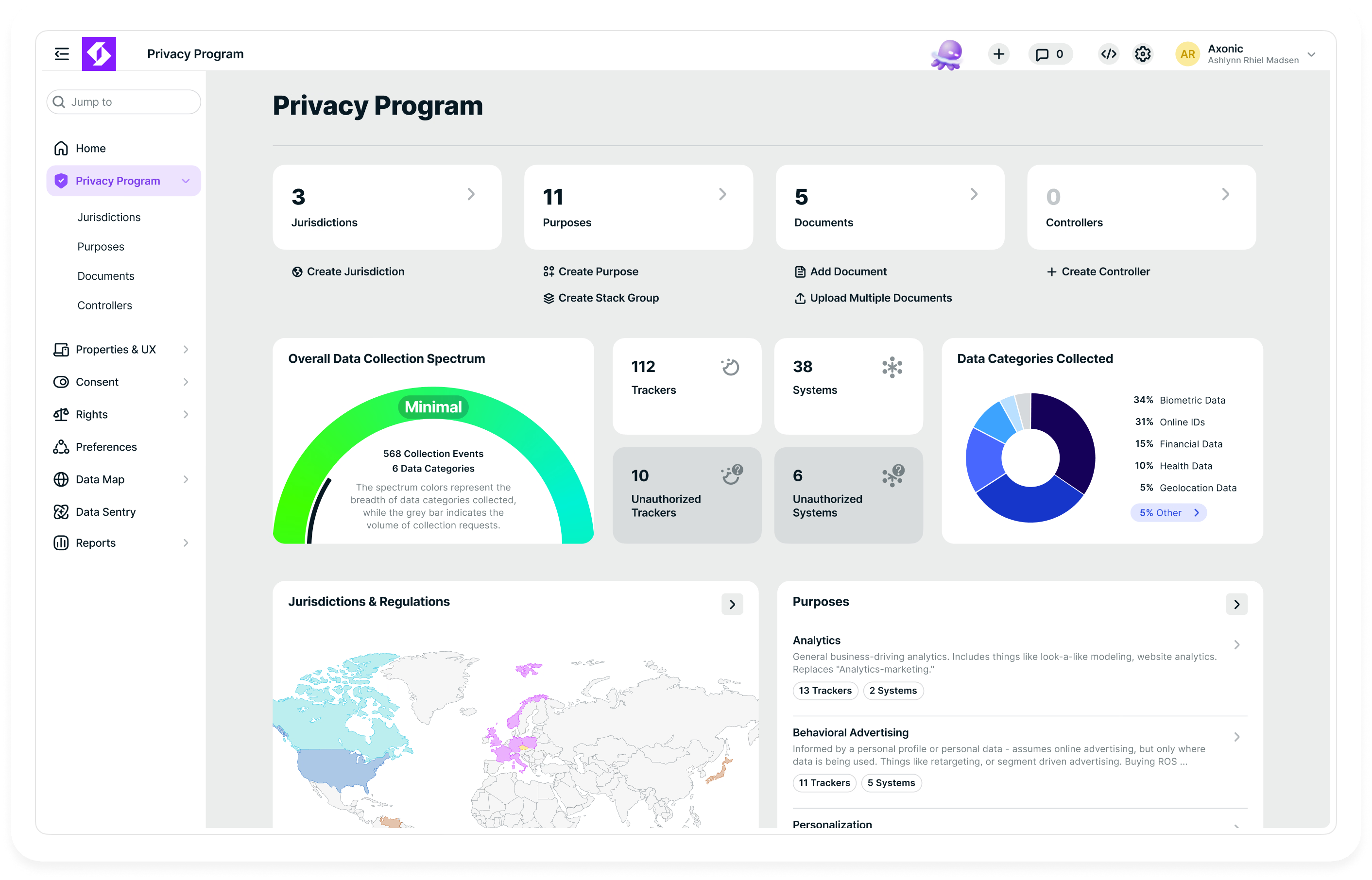
The GDPR has inspired a flurry of new privacy regulations in jurisdictions all over the world, so increasingly companies need to stay compliant not just with the original GDPR but with copycat legislation in places like India, Brazil, and Japan.
With Ketch, you can ensure you’re compliant with the entire global regulatory landscape—without rewriting your codebase every time a new statute is enacted.
Example of successful GDPR compliance
Prestige Consumer Health
Prestige Consumer Healthcare (PCH), a leading provider of over-the-counter products in North America, faced challenges with their "GDPR-everywhere" consent approach, which applied uniform privacy notices across all jurisdictions.
This strategy led to a significant 56% decrease in site traffic at its worst point. To address this, PCH partnered with Ketch to implement a flexible consent management platform that customizes privacy notices based on specific regional requirements.
Ketch's solution enabled PCH to centralize policy creation and tailor privacy experiences per jurisdiction, balancing data utilization with consumer transparency and choice. As a result, PCH experienced a 46% improvement in site traffic compared to their previous cookie banner solution.
“Modern privacy tools like Ketch enable you to achieve growth with data while ensuring privacy compliance.”
- Chief Privacy Officer, PCH brand agency partner
Final thoughts: Preparing your business for GDPR
GDPR compliance is an ongoing process that requires organizations to stay informed about data protection best practices. Businesses should prioritize transparency, invest in secure data handling procedures, and regularly review their compliance strategies to align with evolving regulations.
Contact Ketch today to streamline your compliance and future-proof your privacy strategy.
Read further: 2026 U.S. State Privacy Laws: what you need to know


