




Summarize this article with
The U.S. privacy regulation landscape in 2026 will be shaped by three forces: (1) new comprehensive state privacy laws, (2) major amendments to existing laws, and (3) the most aggressive enforcement climate in U.S. privacy history.
Businesses must upgrade compliance programs to manage expanding consumer rights, youth-protection duties, precise geolocation restrictions, universal opt-out signals, and detailed rulemaking across states.
The state of the U.S. privacy in 2026
With no federal privacy law in sight, states continue to drive privacy regulation through new statutes, youth-safety acts, and high-impact enforcement actions.
The United States remains without a comprehensive federal privacy law. Legislative efforts such as the American Data Privacy and Protection Act (ADPPA) and American Privacy Rights Act (APRA) stalled due to disagreements over preemption and private rights of action.
In the absence of federal standards, states are filling the gap, producing a complex regulatory landscape.
State lawmakers are accelerating privacy activity, passing laws modeled on “Virginia-style” frameworks while adding provisions that address sensitive data, minors’ online safety, neural data, and geolocation. These expansions increase compliance complexity and require more detailed operational controls.
Given this environment, 2026 will demand higher privacy maturity, including automated governance, jurisdiction-aware signals, precise data mapping, and auditable consent UX.
3 new state privacy laws effective in 2026
Three new comprehensive privacy laws—Indiana, Kentucky, and Rhode Island—take effect on January 1, 2026, expanding the number of states that regulate consumer data rights, sensitive data, and opt-out mechanisms.
What U.S. state privacy laws are taking effect in 2026?
In 2026, three U.S. comprehensive state privacy laws take effect on January 1: the Kentucky Consumer Data Privacy Act, Indiana’s Consumer Data Protection Act, and the Rhode Island Data Transparency and Privacy Protection Act.
Dates vary across the 3 new laws. Here’s when each new law goes into effect:
- Kentucky Consumer Data Privacy Act (Kentucky) – effective January 1 2026.
- Indiana Consumer Data Protection Act (Indiana) – effective January 1 2026.
- Rhode Island Data Transparency & Privacy Protection Act (Rhode Island) – effective January 1 2026
Here’s what you need to know about the nuances of these laws.
Indiana Consumer Data Protection Act (INCDPA)
Effective January 1, 2026
The Indiana CDPA applies to businesses that process the data of 100,000 consumers annually, or 25,000 when revenue is derived from selling personal data. The law introduces rights to access, delete, correct, and opt out of targeted advertising, data sales, and profiling.
Indiana follows the Virginia-model framework but reinforces controller duties such as data minimization, purpose limitation, and secure processing. Enforcement authority sits with the Indiana Attorney General.
Kentucky Consumer Data Protection Act (KCDPA)
Effective January 1, 2026
Kentucky’s law applies similar thresholds as Indiana and Virginia. It includes access, deletion, correction, and opt-out rights, but is considered business-friendly due to a permanent cure period and no universal opt-out requirement.
Organizations operating in Kentucky should align their practices with their Virginia-style compliance baseline and maintain evidence that rights requests are fulfilled accurately and promptly.
Rhode Island Data Transparency and Privacy Protection Act (RIDTPPA)
Effective January 1, 2026
Rhode Island introduces a comprehensive regime requiring clear disclosures, data protection assessments for high-risk activities, and consumer rights to access, delete, and opt out of targeted ads and personal data sales.
The Rhode Island AG enforces this law through the state’s deceptive trade practices authority, meaning noncompliance may carry reputational and financial consequences beyond privacy-specific penalties.
Major amendments and children privacy laws effective in 2026
2026 also brings a second wave of regulatory changes, including expanded definitions of sensitive and neural data, strengthened youth protections and children privacy, restrictions on geolocation data, and new obligations for social media platforms and app stores.
Nebraska: Parental Rights in Social Media Act (PRISMA - effective July 1, 2026)
Nebraska introduces a standalone youth-protection law targeting social media platforms:
- Mandatory age verification for all users
- Verifiable parental consent required for users under 18
- Parental rights to manage, monitor, and revoke consent for minor accounts
PRISMA applies specifically to social media services and operates independently of comprehensive state privacy frameworks.
Connecticut: CTDPA amendments (effective July 1, 2026)
Connecticut’s updates expand the definition of “sensitive data” to include neural data and strengthen minors’ rights. The amendments prohibit requiring a child to create a social media account to exercise privacy rights and adjust thresholds to broaden who must comply.
These changes mean privacy programs must include neuro-sensitive data classification, youth-specific DPIAs, and new interface design patterns to accommodate minors’ rights.
Oregon: OCPA amendments (effective January 1, 2026)
Updated obligations significantly affect businesses:
- Ban on sale of precise geolocation data (defined with a 1,750-foot radius).
- Strict restrictions on processing data of consumers under 16 for targeted advertising, sales, or certain profiling.
- End of mandatory cure period for violations.
- Universal opt-out recognition becomes required in 2026.
Businesses relying on geolocation and teen-focused advertising must implement new technical controls to ensure compliance.
Texas: App Store Accountability Act (effective January 1, 2026)
Texas introduces requirements for app stores to:
- Verify user age before account creation
- Obtain parental consent for minors
- Transmit age-related signals to developers
- Enforce age ratings and restrictions
This law operates alongside but separately from the Texas Data Privacy and Security Act, with significant implications for app distribution and user onboarding flows.
Utah: Digital Choice Act (effective July 1, 2026)
Utah introduces social-media-specific data portability and interoperability standards:
- Users must be able to transfer social graph data to other platforms
- Controllers must enable interoperable protocols
- Additional rights apply to social content and connection data
These requirements necessitate architectural updates to support API-based portability.
Virginia: VCDPA Social Media Amendments (effective January 1, 2026)
Virginia imposes one of the strictest youth-protection laws:
- Platforms must determine if a user is under 16
- Minors may only use social platforms for one hour per day, unless parents consent to longer sessions
- Profiling and targeted advertising to minors face tighter restrictions
These rules create significant operational and technical implications for any platform with youth users.
Arkansas: Children and Teens’ Online Privacy Protection Act (effective July 1, 2026)
ACTOPPA extends protections up to age 16:
- Strict data minimization
- Prohibition on targeted advertising to minors without consent
- Stronger parental consent obligations
- Clear limitations on profiling activities
This law requires businesses to redesign experiences for teens and parents.

Compare U.S. state privacy laws side-by-side
Here’s a side-by-side comparison of the key aspects of the upcoming privacy legislation to help you identify overlaps and differences:
New comprehensive privacy laws (Effective January 1, 2026)
Major 2026 Amendments & children privacy laws
What to expect in 2026: enforcement & regulatory trends
2026 is a transition from “law creation” to “law enforcement.” Regulatory agencies now have settlement precedents and technical expectations—especially around opt-out signals, data sharing, sensitive data, and dark patterns.
Trend 1: Increased enforcement across states
Multiple 2025 enforcement actions signal what regulators will target in 2026:
- Honda (2025): Fined for requiring excessive verification for opt-outs and using asymmetric cookie controls (opt-in easier than opt-out).
- Healthline Media (2025): Over $1.5M for failure to honor GPC and misuse of health-related data for advertising.
- Blue Shield of California (2025): Investigation triggered after misconfigured analytics tools shared health information affecting 4.7M members.
- CPPA’s record $1.35M penalty (2025): Focused on employment-data disclosures and ad-tech data-sharing transparency.
These actions show stricter expectations for opt-out governance, ad-tech transparency, health data handling, and data-sharing disclosures.
Trend 2: Expanded rulemaking and technical specifications
New Jersey and Colorado are producing more detailed rules defining:
- Profiling restrictions
- Universal opt-out obligations
- Consumer rights response processes
- Data-retention requirements
- Automated decision-making documentation
- Data protection assessment standards
California is expected to expand rules on cybersecurity audits, automated decision-making, and global opt-out enforcement.
Read more: California Finalizes Regulations to Strengthen Consumers' Privacy
Trend 3: Growing focus on age-appropriate design
States like Texas, California, Maryland, Delaware, Minnesota, Utah, Arkansas, and Virginia are implementing youth-centric design standards. Requirements include:
- Age verification
- Limits on profiling
- Restrictions on targeted advertising
- Prohibitions on manipulative UX
- Daily usage caps (Virginia)
Businesses serving minors must review UX patterns, data collection defaults, and parent-child consent pathways.
Trend 4: Heightened scrutiny of consent and dark Patterns
Regulators are targeting:
- Cookie banners with confusing paths
- Interfaces that bury opt-out options
- Flows that require more steps for refusal than acceptance
- Misleading toggles or color cues
- Pre-selected preferences
The 2025 Honda settlement established that asymmetric opt-out flows are unlawful, setting a clear enforcement template.
Read more: Are dark patterns illegal in 2026? Honda, the law, and UX loopholes
Trend 5: Universal opt-out signals become mandatory
Global Privacy Control (GPC) is now a practical requirement in states such as:
- California
- Colorado
- Connecticut
- Oregon (2026)
- New Hampshire (2025)
Failure to honor GPC has already resulted in fines, making technical detection and system-wide enforcement essential.
Trend 6: Strengthened sensitive data requirements
States are expanding definitions and restrictions for:
- Biometric data
- Neural data (CT, 2026)
- Health data (multiple enforcement cases)
- Precise geolocation (Oregon ban, 2026)
- Teen data under 16 (Oregon, Virginia, Arkansas)
Organizations need robust data classification systems, purpose-binding rules, and DPIAs for sensitive-data processing.
Trend 7: Rising cross-state operational complexity
Divergence across states means compliance programs must handle:
- Different rights-request timelines
- Different definitions for “sale” and “sharing”
- Different age-verification standards
- Different opt-out requirements
- Different sensitive-data categories
- Different cure-period rules
Manual compliance is no longer feasible. Jurisdiction-aware automation is required.
What should privacy leaders focus on now?
2026 requires stronger data governance, automated workflows, and jurisdiction-aware privacy configuration:
- Understand 2026 requirements: Three new laws (IN, KY, RI) and major amendments (CT, OR, TX, UT, VA, AR) introduce new definitions, youth protections, geolocation limits, and consent rules.
- Refresh data inventories: Add fields for neural data (CT), precise geolocation (OR), minors’ data (TX/VA/AR), and social-graph data (UT).
- Enable universal opt-out enforcement: Ensure GPC and other signals are detected and applied consistently across web, mobile, and downstream systems.
- Fix consent and cookie UX: Remove asymmetry, reduce friction, and eliminate dark patterns; ensure opt-out experiences are equal to opt-in.
- Audit ad-tech and data sharing: Review all tags, analytics tools, and partners for sensitive-data leakage and ensure compliant information flows.
- Update privacy notices: Reflect new state obligations, sensitive-data categories, youth restrictions, and geolocation limits.
- Run DPIAs for minors and high-risk processing: Assess profiling, targeted ads, age-verification methods, and sensitive-data processing.
- Use privacy automation: Deploy tools like Ketch for state-specific consent, rights workflows, and configurable jurisdiction-aware controls.
How Ketch can help
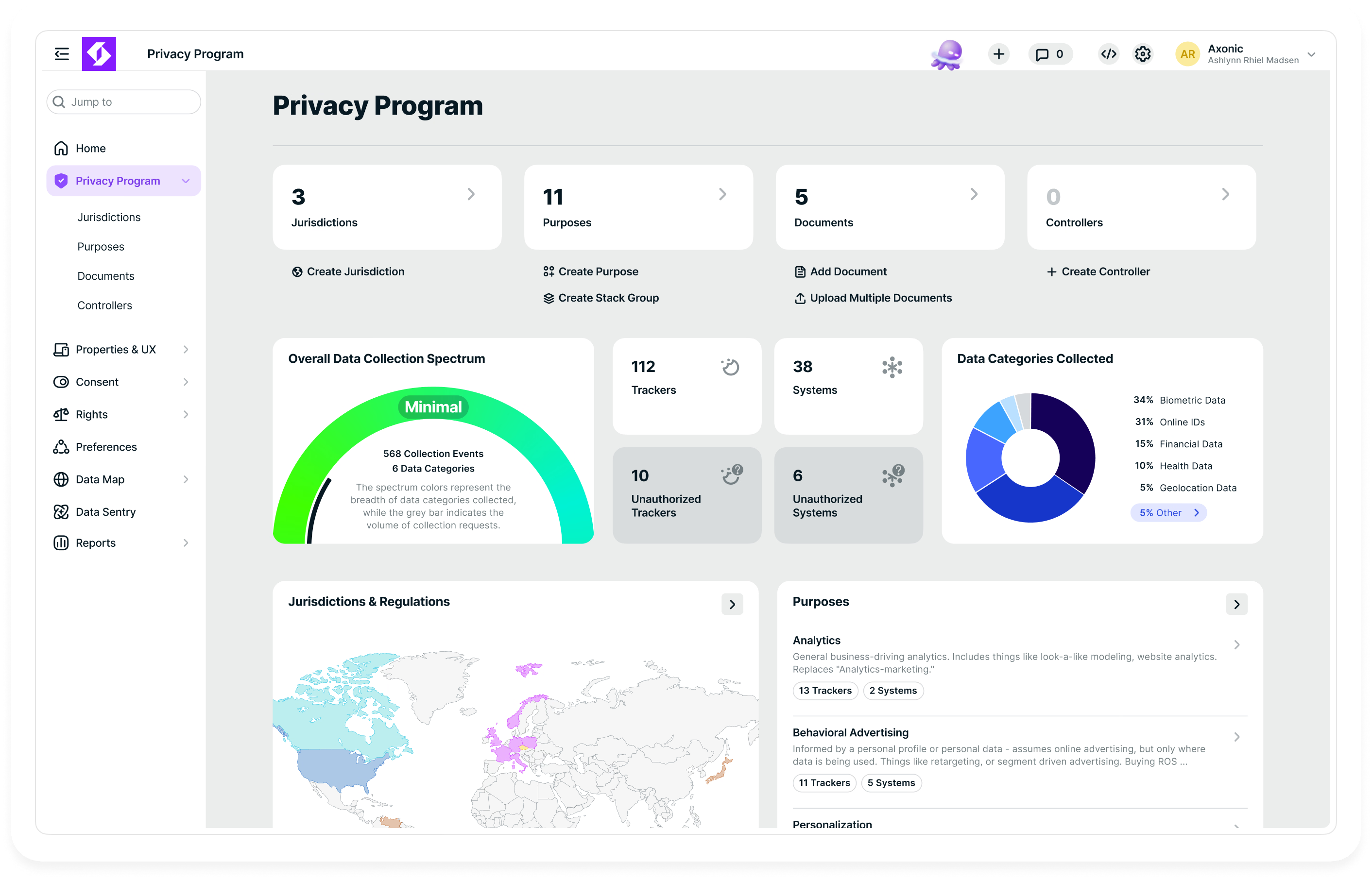
Navigating the evolving privacy landscape can be complex. At Ketch, we offer data privacy solutions that help businesses comply with regulations across jurisdictions. Our tools streamline consent management, data access requests, and compliance workflows, so you can focus on growing your business.
Request a demo to see how Ketch can support your compliance efforts.
“The privacy of our customers' data is very important to us, and we want to make sure we are acting in accordance with their wishes as well as complying with all state laws. Ketch helps us do this without a lot of overhead so we can focus our internal resources on growing our technology capabilities and supporting our aggressive omni-channel growth plans.”
- Mike Early, Chief Technology Officer, Francesca's
Optimizing your compliance strategy is not just a legal requirement–it’s an opportunity to build trust with your customers. Start preparing today to stay ahead of the curve.
Compare: Best data privacy software
Where to go next
This article is a 2026 briefing. For the live US roster and which obligations reach your business, open the US Privacy Law Atlas. For GDPR and the rest of the directory, see the regulatory compliance hub. For the settlements that turned those statutes into program requirements, see Enforcement Analysis.


