



Summarize this article with
Key definitions in the ICDPA
Understanding the terminology used in the Iowa Consumer Data Protection Act is essential for compliance. Here are some critical definitions, as outlined in section 1 of the ICDPA:
- Personal data: Information that identifies, relates to, or could reasonably be linked to an individual, excluding publicly available information.
- Sensitive data: Includes personal data revealing racial or ethnic origin, religious beliefs, health information, and precise geolocation.
- Processing: Any operation performed on personal data, such as collection, use, storage, or dissemination.
- Controller: An entity determining the purpose and means of processing personal data.
- Processor: An entity processing personal data on behalf of a controller.
Who does the ICDPA apply to?
The ICDPA applies to businesses that:
- Process the personal data of 100,000 or more Iowa residents annually; or
- Derive over 50% of their revenue from selling personal data and process data of at least 25,000 consumers.
“Consumer” means a natural person who is a resident of the state acting only in an individual or household context and excluding a natural person acting in a commercial or employment context.
Who is exempt from the ICDPA?
The Iowa Consumer Data Protection Act (ICDPA) exempts government entities, nonprofits, financial institutions under GLBA, HIPAA-covered entities, and educational institutions under FERPA. It also excludes data regulated by federal laws like FCRA and de-identified or employment-related data. Businesses should review exemptions closely.
Key provisions of the ICDPA
1. Consumer rights
Consumer rights are detailed in Section 715D.3 of the ICDPA. The law grants Iowa residents these critical rights:
- Right to access: Consumers can confirm if a business processes their personal data and access that data.
- Right to delete: Consumers can request deletion of personal data they provided.
- Right to data portability: Consumers can obtain a copy of their personal data in a portable format.
- Right to opt out of data sales: Consumers can opt out of the sale of their personal data.
2. Missing rights compared to other state laws
- No right to correct inaccuracies: The ICDPA does not provide consumers the right to correct inaccurate personal data. This contrasts with laws in California, Colorado, Connecticut, and Virginia, for instance.
- No right to opt out of profiling or targeted advertising: The ICDPA does not grant consumers the right to opt out of profiling used to make significant decisions affecting them. Other states, like Colorado and Virginia, offer this right.
- No private right of action: Unlike some other state privacy laws, the ICDPA does not allow consumers to sue businesses directly. Enforcement lies with the Iowa Attorney General.
Is the ICDPA opt-in or opt-out?
The Iowa Consumer Data Protection Act (ICDPA) follows an opt-out model. While it requires businesses to provide an opt-out option for the sale of personal data, it does not explicitly address the right to opt out of targeted advertising. However, businesses must clearly disclose any use of personal data for targeted advertising and provide a means for consumers to opt out.
For sensitive data processing, the ICDPA does not require opt-in consent. Instead, businesses must provide clear notice and allow consumers to opt out if they don’t want their sensitive data processed.
Requirements for businesses under the ICDPA
The Iowa Consumer Data Protection Act (ICDPA) outlines specific requirements for businesses in several key sections, including Section 715D.3, Section 715D.4, Section 715D.5 and Section 715D.6.
To comply with the ICDPA, businesses must meet the following requirements:
- Provide transparency: Offer a clear privacy notice explaining data collection, usage, and opt-out options.
- Ensure data security: Use reasonable measures to protect personal data.
- Respect consumer rights: Allow access, deletion, data portability, and opt-out of data sales.
- Handle sensitive data: Provide notice and allow opt-out for sensitive data processing.
- Maintain contracts: Establish data protection agreements with service providers.
- Avoid discrimination: Ensure equal service regardless of consumers exercising their rights.
Penalties for non-compliance
The ICDPA is enforced by the Iowa Attorney General. Key enforcement details include:
- Fines: Violations may result in penalties of up to $7,500 per violation.
- 90-Day Cure Period: Businesses are given 90 days to address and rectify any alleged violations before penalties are imposed.
The Attorney General can seek reimbursement for investigation and litigation costs if businesses fail to comply after the cure period.
Failing to meet the ICDPA’s requirements can result in significant financial and reputational damage.

The impact of the ICDPA on businesses
The ICDPA introduces both opportunities and challenges for businesses:
- Increased compliance costs: Companies will need to invest in tools, personnel, and processes to meet the new requirements.
- Focus on transparency: Privacy policies and notices will require updates to comply with the law’s stringent disclosure standards.
- Operational changes: Businesses must implement processes for handling consumer rights requests efficiently, including data access, deletion, and portability.
- Enhanced consumer trust: By complying with the ICDPA, businesses can demonstrate their commitment to data privacy, fostering stronger relationships with consumers.
The impact of the ICDPA on consumers
For Iowa residents, the ICDPA is a significant step toward safeguarding personal information. The Iowa Consumer Data Protection Act (ICDPA) impacts consumers by granting some data privacy rights while limiting others.
Consumer benefits
- Data access and control: consumers can access, delete, and obtain copies of their personal data.
- Opt-out of data sales: consumers can stop businesses from selling their personal data.
- Transparency: businesses must disclose data collection and usage practices.
Consumer limitations
- No right to correct data: consumers cannot request corrections to inaccurate personal data.
- No explicit opt-out for profiling or targeted advertising: these protections are not provided.
The ICDPA strengthens consumer privacy but lacks certain rights found in stricter state privacy laws.
How does the ICDPA compare to other data privacy laws?
The ICDPA shares similarities with laws like the Virginia Consumer Data Protection Act (VCDPA) and Colorado Privacy Act (CPA) but also has distinct features.
What makes the ICDPA stand out?
The Iowa Consumer Data Protection Act (ICDPA) is unique due to its approach to consumer rights and sensitive data processing. While it grants consumers the rights to access, delete, and obtain copies of personal data, it does not provide the right to correct inaccuracies or allow them to opt out of profiling or targeted advertising, limiting consumer control compared to other privacy laws.
For sensitive data processing, the ICDPA does not require opt-in consent. Instead, businesses must provide clear notice and give consumers the option to opt out, shifting responsibility to consumers to act if they object. This balance between privacy protection and business compliance makes the ICDPA less restrictive than other state privacy laws.
How Ketch can help with ICDPA compliance
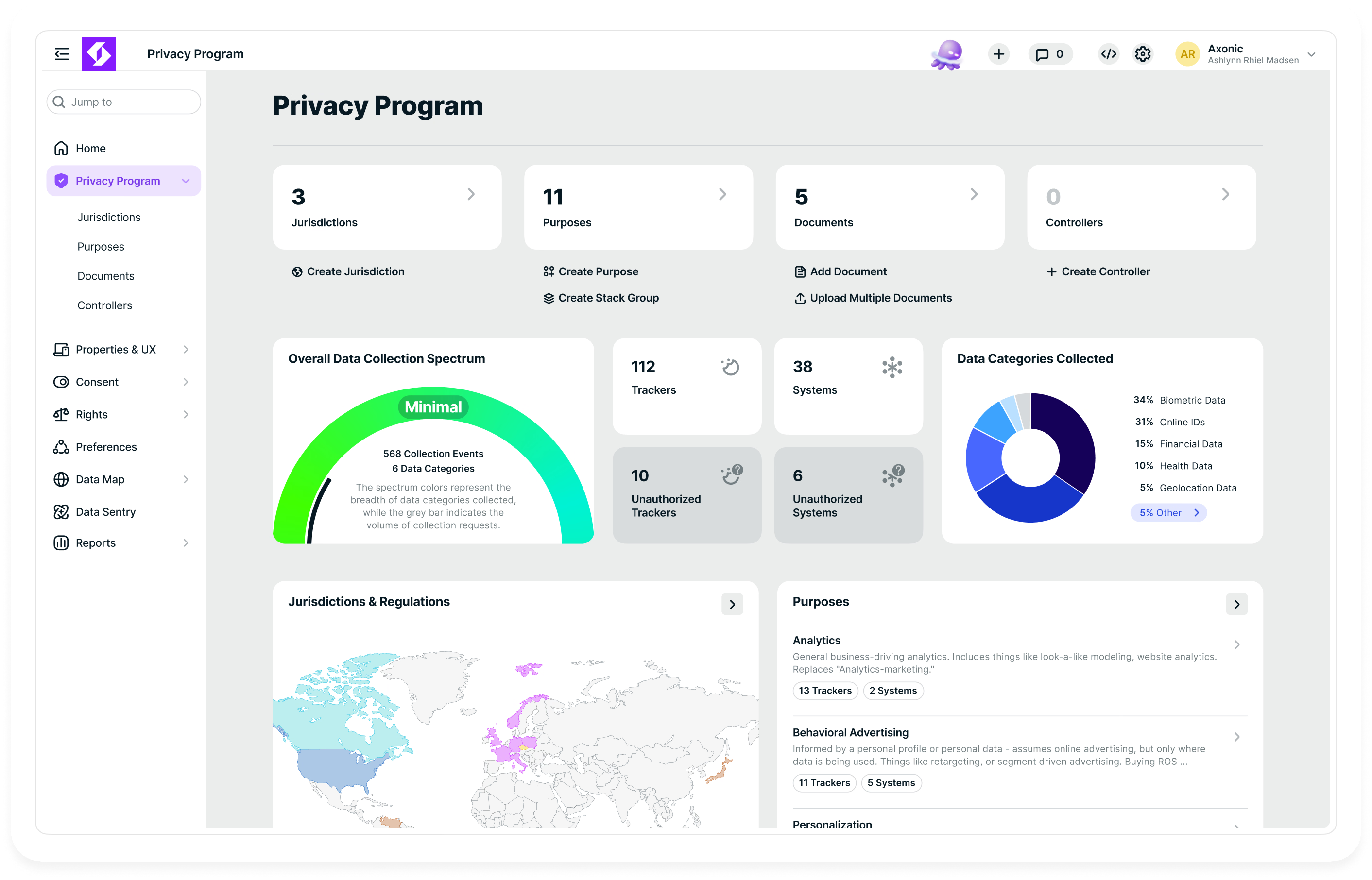
Staying compliant with the ICDPA and other state privacy laws doesn’t have to be overwhelming. The Ketch Data Permissioning Platform simplifies compliance with features like:
- Automated data mapping: Know exactly what data you process and why.
- Centralized consent management: Handle consent for sensitive data with ease.
- Dynamic privacy templates: Customize privacy notices and policies for Iowa and beyond.
Final thoughts on the ICDPA
The Iowa Consumer Data Protection Act represents a significant shift in how businesses operating in Iowa must manage personal data. By taking proactive steps toward compliance, you can not only avoid penalties but also build trust with your customers.
Ready to streamline compliance for Iowa and other jurisdictions? Contact Ketch today and future-proof your privacy strategy.
Read further: 2026 U.S. State Privacy Laws: what you need to know


