



Summarize this article with
Key definitions in the NHPA
Familiarizing yourself with key terms in the New Hampshire Privacy Act is crucial for compliance, as defined in Section 359-C:3 of the NHPA:
- Personal data: Information identifying or reasonably linkable to an individual, excluding publicly available data.
- Sensitive data: Includes personal data revealing racial or ethnic origin, religious beliefs, health conditions, sexual orientation, or precise geolocation.
- Processing: Any operation performed on personal data, such as collection, storage, or dissemination.
- Controller: An entity determining the purposes and means of processing personal data.
- Processor: An entity processing personal data on behalf of a controller.
Who must comply with the NHPA?
The New Hampshire Privacy Act applies to businesses that:
- Conduct business in New Hampshire or target its residents: Entities must operate within the state or offer products or services to New Hampshire residents.
- Meet specific data processing thresholds:
- Control or process personal data of at least 35,000 unique New Hampshire consumers annually, excluding data processed solely for payment transactions.
- Or control or process personal data of at least 10,000 unique New Hampshire consumers and derive over 25% of gross revenue from the sale of personal data.
These thresholds are lower than those in many other state privacy laws, broadening the scope of affected businesses.
In the New Hampshire Privacy Act (NHPA), Section 507-H:1(VIII) defines "consumer" as:
"an individual who is a resident of this state acting only in an individual or household context. 'Consumer' does not include an individual acting in a commercial or employment context."
This definition specifies that the term "consumer" applies solely to New Hampshire residents engaging in personal or household activities, explicitly excluding those acting in business or employment roles.
NHPA exemptions
The New Hampshire data privacy law excludes certain entities and types of data, including:
- Entities: Government bodies, nonprofits, financial institutions under GLBA, and HIPAA-covered entities.
- Data: FERPA, FCRA, Driver’s Privacy Protection Act-regulated data, de-identified data, and employment-related data.
Key provisions of the NHPA
The New Hampshire Privacy Act establishes several key provisions to protect consumer data:
1. Consumer rights
- Access: Consumers can confirm if a controller is processing their personal data and access that data.
- Correction: Consumers can correct inaccuracies in their personal data.
- Deletion: Consumers can request the deletion of their personal data.
- Data portability: Consumers can obtain a copy of their personal data in a portable format.
- Opt-out: Consumers can opt out of the processing of their personal data for targeted advertising, the sale of personal data, or profiling in furtherance of decisions that produce legal or similarly significant effects.
Is the NHPA opt-in or opt-out?
The New Hampshire Privacy Act (NHPA) primarily operates on an opt-out model, allowing businesses to process personal data without prior consent, provided they inform consumers and offer a means to opt out. However, for sensitive data—such as information revealing racial or ethnic origin, health conditions, or precise geolocation—the NHPA requires businesses to obtain explicit consent before processing.
Additionally, the NHPA mandates that businesses honor universal opt-out mechanisms, like the Global Privacy Control (GPC), enabling consumers to opt out of data sales and targeted advertising across multiple platforms seamlessly.
2. Business obligations
- Data minimization: Limit the collection of personal data to what is adequate, relevant, and reasonably necessary for disclosed purposes.
- Purpose limitation: Process personal data only for purposes compatible with those disclosed to the consumer.
- Security measures: Implement reasonable administrative, technical, and physical data security practices.
- Consent for sensitive data: Obtain consumer consent before processing sensitive data, which includes information revealing racial or ethnic origin, religious beliefs, health conditions, sexual orientation, citizenship or immigration status, genetic or biometric data, data from known children, and precise geolocation data.
3. Data protection assessments
Conduct assessments for processing activities that present a heightened risk of harm to consumers, including targeted advertising, the sale of personal data, profiling, and processing sensitive data.
4. No private right of action
Enforcement is limited to the New Hampshire Attorney General, reducing the risk of private lawsuits.
Requirements for businesses under the NHPA
Under the New Hampshire Privacy Act, businesses must:
- Provide transparency: Offer clear privacy notices about data collection, use, and consumer rights.
- Enable consumer rights: Allow access, correction, deletion, and opt-outs for targeted ads, data sales, and profiling.
- Obtain consent: Secure explicit consent for processing sensitive data, including biometric and health information.
- Minimize data: Collect only necessary data and process it for disclosed purposes.
- Ensure security: Implement safeguards to protect personal data.
- Conduct assessments: Evaluate high-risk data activities like targeted advertising and sensitive data processing.
- Respond to requests: Address consumer requests within 45 days and provide appeal processes.
These requirements protect consumer privacy while promoting business accountability.
Penalties for non-compliance
The NHPA imposes fines of up to $10,000 per violation, with a 60-day cure period to address issues. After December 31, 2025, the cure period becomes discretionary, allowing the Attorney General to decide whether to offer businesses a chance to rectify violations before penalties are enforced.
Fines
Non-compliance can result in civil penalties of up to $10,000 per violation. Each instance of non-compliance is considered a separate violation, potentially leading to substantial fines for multiple infractions.
Cure Period
Upon notification of a violation, businesses are granted a 60-day period to address and rectify the issue. If the violation is resolved within this timeframe, the New Hampshire Attorney General may choose not to impose penalties. However, after December 31, 2025, the right to cure becomes discretionary, meaning the Attorney General may decide whether to offer an opportunity to correct the violation before enforcing penalties.
It's crucial for businesses to proactively ensure compliance with the NHPA to avoid these penalties and maintain consumer trust.

The impact of the NHPA on businesses
The NHPA introduces both opportunities and challenges for businesses.
Opportunities
- Consumer trust: Compliance demonstrates a commitment to privacy, building trust with New Hampshire residents.
- Competitive advantage: Early compliance positions businesses as leaders in privacy protection, differentiating them in the market.
- Efficiency: Data minimization streamlines operations, reducing storage and processing costs.
- Legal alignment: Adhering to the NHPA helps prepare for compliance with similar laws across other states.
- Enhanced security: Stronger safeguards reduce the risks and costs associated with data breaches.
Challenges
- Compliance costs: Significant investment is required for systems, training, and legal expertise to meet NHPA requirements.
- Operational changes: Revising data collection, consent, and processing practices may disrupt existing workflows.
- Consent management: Securing and managing explicit consent for sensitive data adds technical and administrative complexity.
- Penalties: Non-compliance risks fines up to $10,000 per violation, impacting finances and reputation.
- Interstate compliance: Businesses operating in multiple states must navigate varying privacy laws, increasing regulatory complexity.
Proactively addressing these challenges can help businesses turn compliance into a strategic advantage.
The impact of the NHPA on consumers
The New Hampshire Privacy Act (NHPA) benefits consumers by:
Empowering rights
- Access, correct, delete, and obtain their personal data.
- Opt out of targeted ads, data sales, and profiling.
Enhancing privacy
- Requires consent for sensitive data like health or biometrics.
- Mandates transparency on data practices and stronger security measures.
Increasing awareness
- Promotes accountability and educates consumers about their rights.
Limitations
- Consumers rely on the Attorney General for enforcement (no private lawsuits).
- Exemptions for small businesses and nonprofits may limit coverage.
The NHPA strengthens consumer control and protection over their personal data.
How the NHPA compares to other U.S. data privacy laws
The New Hampshire Privacy Act (NHPA) shares significant similarities with several other U.S. state data privacy laws, particularly the Virginia Consumer Data Protection Act (VCDPA) and Colorado Privacy Act (CPA). These laws, like the NHPA, follow a framework inspired by international privacy standards, such as the EU's General Data Protection Regulation (GDPR).
What makes the NHPA stand out?
The New Hampshire privacy law strengthens consumer privacy by requiring businesses to honor universal opt-out signals, including the Global Privacy Control (GPC).
This mandate allows consumers to automatically opt out of data sales and targeted advertising through browser settings or device configurations, without manually submitting requests to each business. While only a few states like California and Colorado have similar requirements, New Hampshire’s inclusion of GPC underscores its commitment to proactive consumer privacy protection.
Businesses operating in the state must implement technology systems that can detect, interpret, and process GPC signals, ensuring seamless compliance and enhancing consumer data control. This makes the NHPA one of the most forward-thinking privacy laws in the U.S. privacy landscape.
How Ketch can simplify NHPA compliance
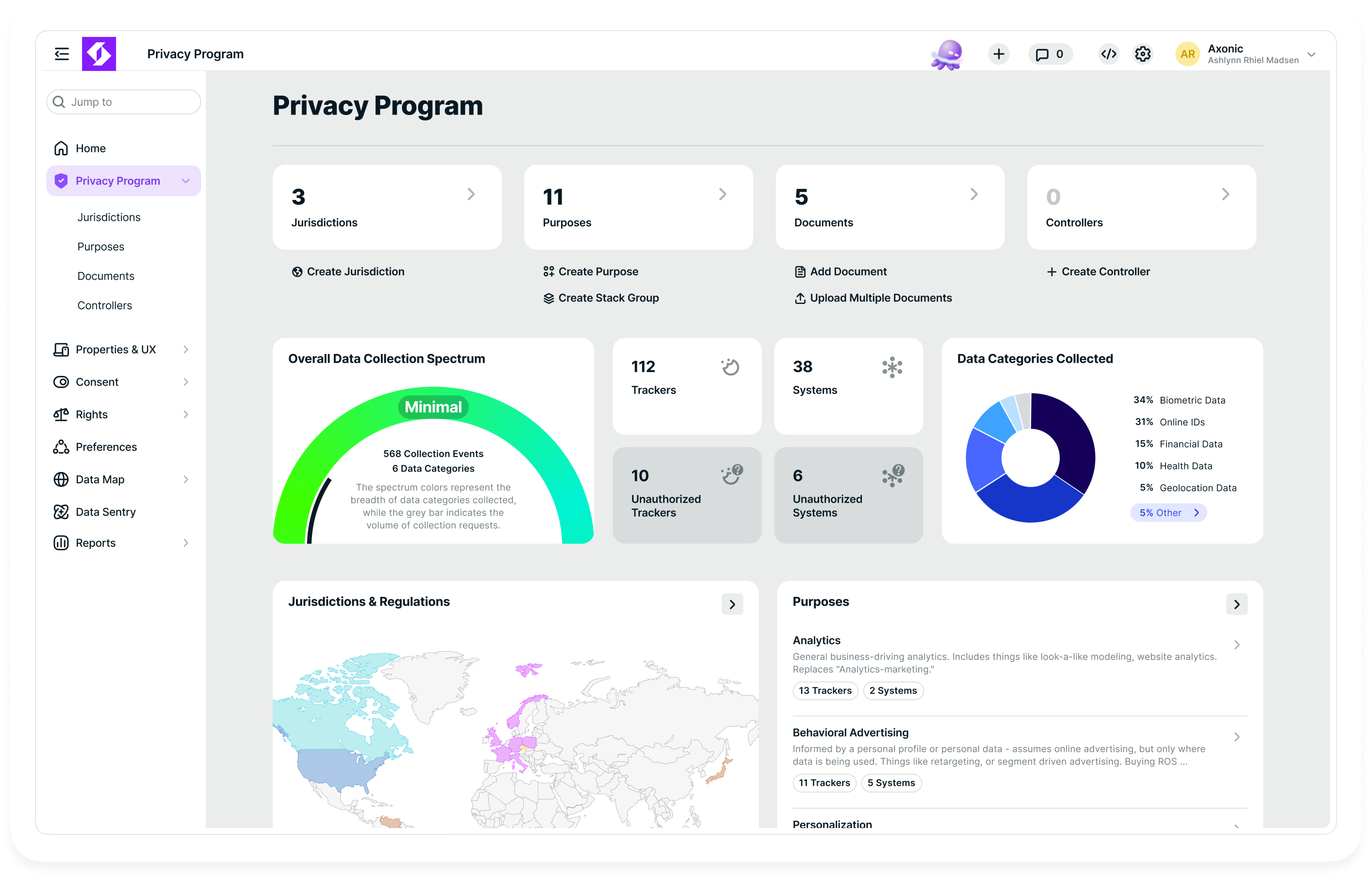
Complying with the NHPA and other state privacy laws can be simpler than you think. The Ketch data permissioning platform helps businesses stay compliant by:
- NHPA policy template: Ketch Consent Management includes a pre-built policy template for the New Hampshire Privacy Act, with ability to customize rights as desired, no coding required to make changes.
- Right for Consumers to Opt Out: The law permits consumers to opt out of the processing of personal data for the sale of personal data or for targeted advertisements. With Ketch Consent Management, businesses can offer clear privacy notices with this option specific to Delaware residents.
- Requirement to respect universal opt-out mechanisms (UOOMs): UOOMs are tools that a consumer can use to opt out of online personal data processing. The most well-known and recognized example is the Global Privacy Control (GPC). Ketch makes it easy for companies to comply with GPC signals, enabling automatic recognition of GPC in the consumer’s browser.
- Data subject rights: The law provides consumers with right to access, correct, delete, and obtain a copy of their personal data. Ketch enables end-to-end DSR fulfillment with capabilities like drag-and-drop workflow builder, smart routing, and task-level automation.
Final thoughts: Preparing your business for NHPA Compliance
The New Hampshire Privacy Act represents a significant advancement in consumer data protection for New Hampshire residents. Preparing for compliance now will help avoid penalties and strengthen trust with your affected customers.
Contact Ketch today to streamline your compliance and future-proof your privacy strategy.
Read further: 2026 U.S. State Privacy Laws: what you need to know


