



Summarize this article with
In a world where data flows between countless systems and platforms, data mapping is the key to ensuring accuracy, data privacy compliance, and actionable insights. Let's explore what data mapping is, why it matters, and how the best tools and practices in 2025 can help your organization streamline data management and privacy operations.
What is data mapping?
Data mapping is the process of identifying and visualizing how data moves across your internal systems, cloud platforms, and third-party tools. It reveals where data is located, how it flows, and how it's transformed from one system to another. This visibility is essential for integrating systems, automating workflows, complying with privacy regulations, and building trustworthy data pipelines.
In other words, data mapping is the practice of connecting data fields from one system or format to corresponding fields in another. It establishes clear relationships between different datasets, enabling smooth data migration, integration, and transformation. By defining these connections, organizations ensure that information remains consistent, accurate, and meaningful as it moves across platforms or is combined with other sources.
Key components of data mapping
Effective data mapping relies on several foundational elements that ensure data flows accurately and securely between systems:
- Source data: Originating datasets (e.g., CRM, ERP, cloud storage)
- Destination data: Target systems where the data is being mapped to
- Transformation logic: Rules that format, restructure, or enrich data
- Metadata: Definitions and descriptions of data fields
- Mapping documentation: Visual or tabular representation of relationships

Why is data mapping important?
Data mapping ensures the accuracy, consistency, and compliance of your data. Here’s what effective data mapping unlocks:
- ✅ Data accuracy and consistency: Prevents mismatched fields and logic errors as data moves between systems.
- ✅ Faster analytics and reporting: Simplifies integration for BI tools, dashboards, and data warehouses.
- ✅ Regulatory compliance: Enables transparency and traceability to meet privacy laws like GDPR, CCPA, and HIPAA.
- ✅Risk management: Reduces exposure by highlighting sensitive or misrouted data.
- ✅ Improved collaboration: Aligns IT, privacy, and business teams around a shared source of truth.
Without data mapping, organizations face inconsistent reporting, privacy risks, and reduced decision-making power.
Why data mapping is essential for effective data management
Data mapping plays a vital role in many data management processes by aligning data across systems to maintain integrity and usability. It's essential for:
- Data integration: Merging information from different sources into a unified structure
- Data migration: Transferring data between systems without losing context or accuracy
- Data transformation: Reformatting data to match the requirements of target systems or applications
- Data analysis: Ensuring data consistency so insights drawn are reliable and meaningful
- Data lineage: Tracing where data originates and how it moves and changes across systems
Key benefits of data mapping for your organization
Implementing effective data mapping offers several advantages that improve how data is managed, understood, and utilized:
- Improved data quality: Promotes consistency and accuracy across systems
- Streamlined data processes: Makes data integration and migration more efficient
- Enhanced data analysis: Supports more reliable and insightful reporting
- Reduced errors: Lowers the risk of mismatches and data inconsistencies
- Improved data governance: Clarifies data relationships and supports regulatory compliance

What goes wrong without data mapping?
As organizations scale, data is scattered across applications, APIs, CRMs, and data lakes. It becomes increasingly important to ensure accurate and reliable data. A single data discrepancy could result in poor business decisions, legal complications, and financial mistakes.
Without proper mapping, you risk:
- ❌ Incorrect analytics from misaligned fields
- ❌ Compliance failures due to unidentified data flows
- ❌ Missed insights from siloed data
- ❌ Costly rework in migrations and integrations
Research shows that 77% of organizations report data quality issues, with 91% attributing its direct impact on their company's performance. A single mistake in mapping can snowball into poor decisions, delays, or privacy violations.
“Poor data quality and pipeline debt create organizational friction between stakeholders, with consequences like degraded confidence. This survey made it clear that data quality issues are prevalent and they’re harming business outcomes.”
- Abe Gong, CEO and Cofounder of Superconductive
Data mapping prevents these issues by ensuring that data fields tally with each transfer and transformation layer and stays consistent in every source. You can achieve a seamless data mapping process by applying specialized tools that automate complex data mapping according to your processing needs.
Common challenges and how to overcome them
How it works - The data mapping process explained
It is important to identify the types of data mapping involved, such as mapping on the cloud versus on-premise practices. Your team must ensure that the transferred data remains accurate after the mapping, with data correlations kept intact and data presented in the relevant format.
What are the steps of data mapping?
The following steps can help your team achieve the best data mapping practices:
- System discovery scan
- Data classification
- Mapping logic creation and testing
- Automated deployment
- Ongoing monitoring and updates
Read more: Automated data mapping
1. Conduct a system discovery scan
A thorough system discovery scan helps you assess the data within your relational and non-relational databases, classifying data sets for streamlined management. You could apply advanced technology like responsive machine learning to drive a predictive assessment and management of your ongoing data processes.
Increasingly, this discovery work is being handed off to autonomous AI agents that can scan, classify, and flag new data sources without waiting on a manual review cycle.
Read more: Agentic data mapping, explained
2. Classify the information
Deep data discovery scans inform your team about the sensitive and personal information in internal and external systems, each requiring added care and attention. Once you have identified these data sources, you can update user preference and privacy management with real-time accuracy.
3. Test the mapped logic
Before completing a mapping process, it is strategic to test a sample of your data logic to ensure that it is progressing in the right direction. Consider applying automated tools to verify that your software runs smoothly as intended. The measure helps you minimize the work required in the event of a mistake or error. These include white box testing, where you can add, update, or delete data that would execute a system trigger.
4. Deploy the mapping process
Once your sampled data logic passes its respective tests, you can go ahead with the rest of the process by leveraging a reliable data mapping tool.
5. Maintain and regularly update your mapping processes
Maintaining and updating your data is equally as important as establishing the flow. It is crucial to ensure that you continue following the best data mapping techniques with the addition and modification of data sources and destinations.

Data mapping best practices
Whether you’re mapping for privacy, analytics, or systems integration, here are essential strategies:
- ✅ Start with automated discovery: Manual surveys are outdated. Automated scans reduce blind spots.
- ✅ Focus on privacy: Tag sensitive data early and integrate privacy workflows directly.
- ✅ Use visual tools: Look for mapping tools that provide flow diagrams and relationship visualizations.
- ✅ Test before deploying: Build sandbox environments for white-box testing of mappings.
- ✅ Treat mapping as a living process: Set schedules for routine validation and reclassification

Additional tips for effective data mapping
To ensure your data mapping initiatives are accurate, scalable, and compliant, follow these proven best practices:
- Use automated discovery to reduce manual audits
- Start small and scale with repeatable templates
- Prioritize data quality and data lineage
- Use visual tools to build clarity and stakeholder understanding
- Validate logic through sandbox testing
- Keep documentation current and accessible
Read more: How to start a successful privacy data mapping project
Data mapping and GDPR compliance
The General Data Protection Regulation (GDPR) is a stringent data privacy and security law that applies to organizations within the EU and companies that target or collect the data of EU residents.
Data mapping helps your company fulfill GDPR criteria by providing a clear and detailed view of your data movements, driving the following processes:
Implementing data protection measures
The transparent layout of data movement allows your team to determine the potential privacy risks involved in your databases. As such, you can implement the right protective measures, such as setting up security controls, qualifying data transfers, and managing user access privileges.
Checking against consent and agreements
A portion of GDPR revolves around user consent and agreement conditions. Data mapping helps your team zoom in on the legal aspects of each user interaction and the purpose of data processing interactions. By mapping the data, teams can identify the legal procedures required to gather privileged information, such as seeking explicit consent.
Minimizing data
The GDPR follows the principle of minimization or data avoidance, where data processors should limit data use to those "adequate, relevant and limited to what is necessary in relation to the purposes for which they are processed." Data mapping makes it easier to monitor and shortlist data points to fulfill the principle of minimization.
Supporting data protection impact assessments (DPIAs)
Data mapping provides the key insights (i.e., data flow descriptions/diagrams and potential privacy risk factors) for creating the DPIAs that identify and mitigate data protection-related risks. The GDPR declares DPIAs mandatory for new high-risk processing projects.
Identifying data sources and channels
An organized data mapping process enables your team to identify the exact source of confidential and personalized information. By doing so, you can determine if the targeted data falls under the jurisdiction of the GDPR and ensure necessary compliance.
Examples of effective data mapping
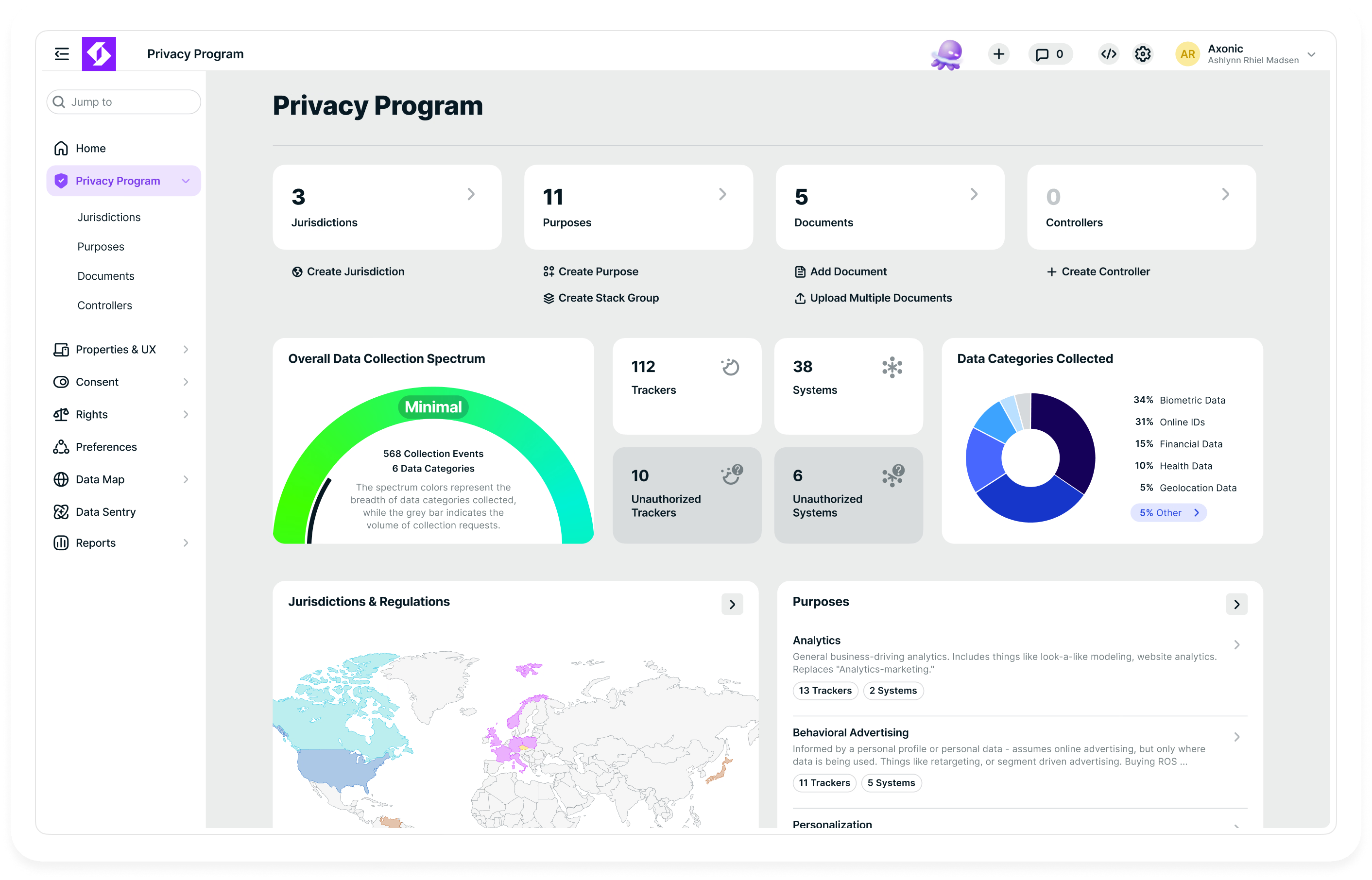
Ketch offers a prime example of data mapping. The Ketch Data Permissioning Platform stands out among data mapping tools for privacy. Ketch's advanced data mapping tool aids businesses in system and data discovery, collaboration amongst involved stakeholders, and speed to value in producing results to inform privacy risk decisions. These actions are critical for data mapping and compliance.
Ketch's advanced data mapping capabilities can give your businesses a clearer understanding of your data structure. This enhanced understanding can enable your business to better harness your data, allowing for more clarity in strategic planning and decision-making.
In addition, by offering features such as data discovery and classification, Ketch data mapping software enables your business to efficiently locate, classify, and catalog your data. Using such tools paves the way for businesses to build trust with their consumers, emphasizing responsible data handling and facilitating company growth.
In the retail industry
A global brand uses Ketch to track customer consent and preference data across marketing tools, enabling GDPR-aligned personalization.
In the healthcare industry
An enterprise maps patient records across EHR and analytics tools, ensuring HIPAA compliance and continuity of care.
In the finance industry
A fintech maps sensitive transaction and identity data for real-time fraud detection and SOC2 reporting.
What is the best data mapping software?
When choosing a data mapping tool, look for:
- Real-time automation
- Centralized visibility
- Integration with compliance workflows
- Scalable architecture for cloud and on-prem
Data mapping tools examples
Data mapping tools automate data collection from multiple sources before formatting and organizing them according to the requirements of a target database.
Some of the most popular techniques include:
- Conditional mapping: The process applies data mappings based on corresponding user-defined conditions.
- Constant mapping: Imputing fixed or constant values to a targeted data field regardless of source information.
- Lookup mapping: A process that maps lookup values to source data.
When it comes to managing a large-scale organization or enterprise, you'll need a trusted solution that you can rely on to run smoothly across data sources and web services, provide real-time mappings, and resolve discrepancies without fuss. There are lots of options but these are some of the best data mapping tools available.
Compare the top data mapping software of 2025
Here are the best data mapping tools in 2025, known for performance, scalability, and privacy alignment:
- Ketch – Real-time mapping, compliance-ready, ML-powered insights
- Informatica Cloud Data Integration – Enterprise-grade ETL and mapping
- Talend Data Fabric – Open-source and scalable
- MuleSoft – API-first data mapping with automation
- Astera Centerprise – Visual data integration with strong support for transformations
Each solution provides robust capabilities for mapping structured and semi-structured data across environments.
Read more: How to choose the best data mapping software
Ketch: A trusted automated data mapping solution
Ketch offers one of the most advanced automated data mapping software platforms for privacy and compliance. Our platform helps you:
- Detect and map sensitive personal data in real time
- Automate privacy governance across your ecosystem
- Maintain accurate, up-to-date data lineage
- Align with global regulations like GDPR and CCPA
- Replace surveys and manual audits with intelligent discovery
Ketch ensures your data is always mapped, monitored, and managed—helping your teams operate with confidence and clarity.
Data mapping is no longer optional for modern organizations. From compliance to analytics, a well-structured data mapping strategy ensures every data point is trusted, traceable, and actionable.
Request a demo with Ketch to optimize your data mapping capabilities and eliminate the complexities of privacy management.