




Summarize this article with
Agentic data mapping uses AI agents to automatically discover systems, classify data, and maintain an always-current data map, without manual surveys or spreadsheets. Ketch connects to 400+ platforms, ingests vendor contracts, and surfaces gaps between your legal obligations, documented policies, and live systems. Privacy teams review and approve what agents find, rather than doing the discovery work themselves.
The moment you finish building a data map, it starts going stale.
- A new SaaS tool gets onboarded.
- A vendor updates their subprocessor list.
- Engineering ships a feature that touches a new data category.
And then: somewhere in a spreadsheet that nobody has opened in three months, the official record of your organization's data practices sits quietly, confidently wrong.
Privacy teams already know this. It is not a knowledge gap, it is an infrastructure gap. The problem was never that privacy professionals didn't understand what a data map should contain. The problem was that building one accurately required continuous coordination across engineering, legal, and vendor management, and maintaining it required the same effort, on repeat, forever.
The Ketch Agent Network addresses that infrastructure gap directly. Ketch agentic data mapping connects to your live systems, reads your contracts, classifies your data, and keeps the map current automatically, with privacy teams reviewing and approving what agents surface, rather than doing the discovery from scratch.
Read further: Agentic privacy explained
Why traditional data mapping fails at scale
Data mapping is a foundational requirement under privacy laws in every major market. GDPR Article 30 requires organizations to maintain records of processing activities (ROPAs). The CCPA and its amendment, CPRA, require businesses to understand what personal information they collect, where it comes from, how it's used, and with whom it's shared. State laws in Texas, Montana, Oregon, and more carry similar requirements.
The regulatory mandate is clear. The operational reality is harder.
Gartner research finds that fewer than 30% of organizations can automatically enforce data governance and usage policies. That means the overwhelming majority of enterprises are running their privacy programs on manual processes, surveys sent to system owners, DPAs read by hand, spreadsheet rows updated when someone remembers to update them.
The result: privacy teams spend the majority of their time gathering context before they can identify a single risk. Assessments start from a blank page. ROPA exports require a full audit sprint. And when a regulator or plaintiff's attorney sends a demand letter, the first question — "what data do you have, and where does it go?" — takes weeks to answer with confidence.
Read further: Why privacy assessments fail as a risk control
The enforcement cost of incomplete data maps
Incomplete or inaccurate data mapping is not an abstract risk. Regulators treat it as direct evidence of non-compliance.
In 2024, the California Privacy Protection Agency reached a $632,000 settlement with Honda. The agency found that Honda shared personal data with adtech partners without proper data processing agreements and failed to consistently honor consumer opt-out preferences, both problems that a current, accurate data map would have made visible before regulators did.
Healthline Media paid $1.55 million to settle with the California AG after sharing sensitive health browsing data with advertisers without valid consent. The underlying issue was a failure to understand — at the system level — what data was flowing where and on what legal basis.
In France, CNIL fined SHEIN €150 million for failures in data governance and in the fulfillment of consumer rights. The common thread across these enforcement actions is that organizations lacked sufficient operational visibility into their data practices to catch problems before they became regulatory findings.
These are not edge cases. They are a preview of what aggressive enforcement looks like when data maps are incomplete, manual, or static.
Ketch agentic data mapping explained
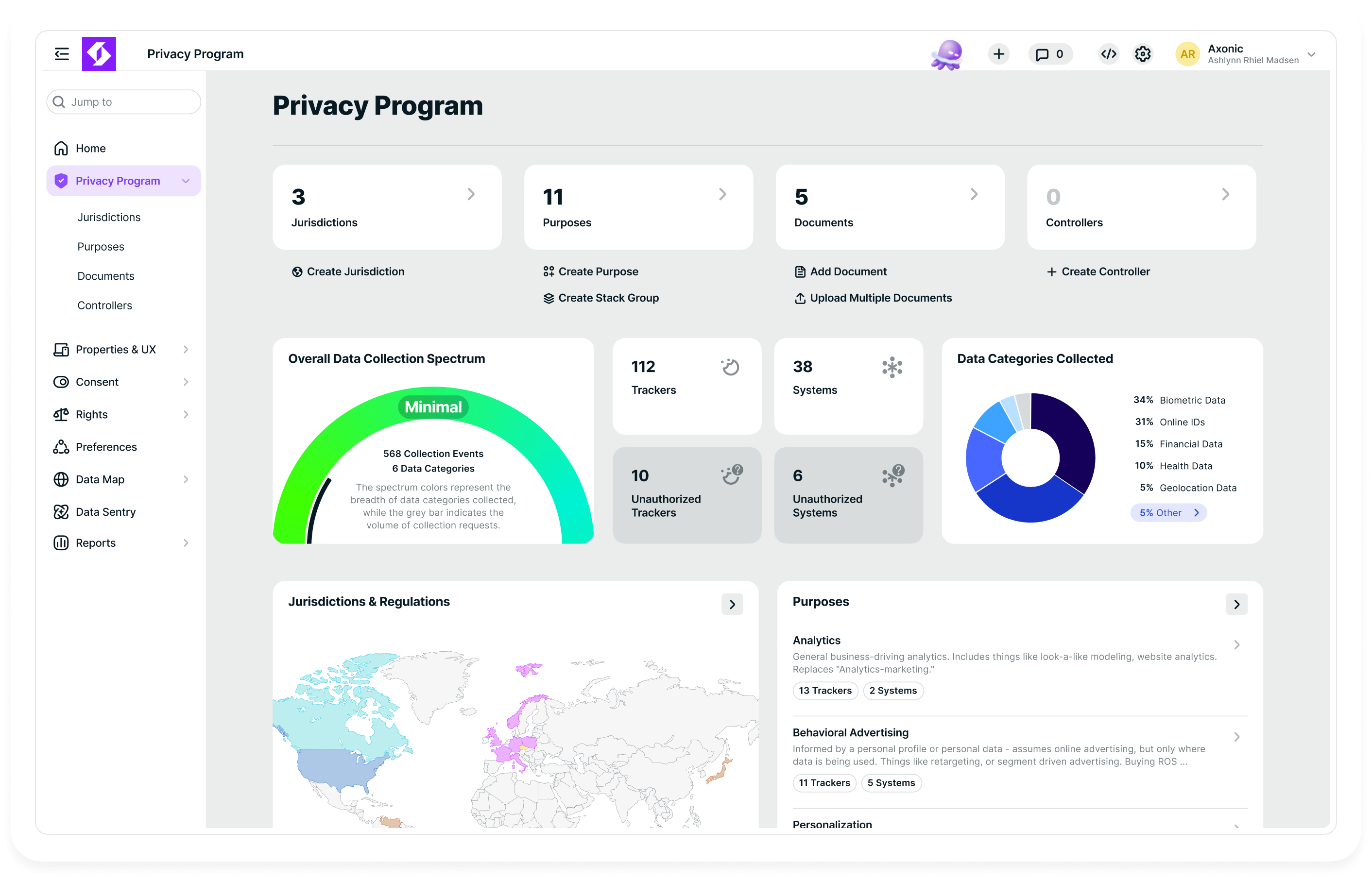
Ketch agentic data mapping builds and maintains your data map automatically, using AI agents that connect to your systems, synthesize your vendor agreements, and classify data continuously, without requiring privacy teams to chase survey responses or manually reconcile sources.
The Ketch Agent Network connects to 400+ platforms, including third-party SaaS tools like Braze, Snowflake, Salesforce, and others commonly found in enterprise data stacks. When a new system appears in your environment, agents detect it. When a vendor updates their data practices, agents scan the documentation. When data appears in a connected system for the first time, agents classify it.
The result is a data map that reflects operational reality — not the last time someone had bandwidth to update a spreadsheet.
What Ketch agents do that privacy teams currently do manually
System discovery and classification
Every connected system is automatically discovered and profiled. Agents classify data sensitivity levels, data categories, and data types across custom fields — the exact details that enterprise privacy programs need to answer regulator questions accurately.
In a live demonstration of Ketch Data Mapping, a user opens their dashboard to find 42 systems already mapped, nine new systems detected since the last session, and one flagged issue requiring remediation. That summary — available immediately, without a discovery sprint — represents weeks of manual work, compressed into an always-current feed.
Historically, that classification work was done by a person or a team. The moment it was done, it was already a candidate for staleness. If Braze or Salesforce made back-end changes to their data handling, no one would know until the next quarterly review — if a quarterly review was even scheduled.
Contract intelligence
Agents ingest vendor DPAs, subprocessor lists, and custom contracts. They extract AI usage clauses, data retention policies, security measures, and subprocessor relationships from legal text — and map that information directly to the systems in your data map.
This matters because DPA gaps are one of the most common findings in regulatory enforcement and internal audits. Knowing what your contracts require and comparing that against what your systems are actually doing closes a gap that most privacy teams can only close manually and intermittently.
Processing activity detection
Agents generate processing activity records with full system context: what data is processed, for what purpose, and on what legal basis. Those records are ready for ROPA export, which means producing regulator-ready documentation becomes a reporting function rather than a research project.

The Insights Panel: where agents surface what needs attention
One of the most practically useful capabilities in Ketch Data Mapping is the Insights Panel, a feed of prioritized findings generated by the Ketch Agent Network. Each “Insight” represents a gap between what regulations require, what your policies say, and what your systems are actually doing.
Agents compare across three domains simultaneously:
When those three domains don't match, an insight is generated. Each insight names the gap specifically, links to the relevant regulatory citation, and includes recommended next steps. Privacy teams can assign ownership, add comments, and track resolution — all within the same view.
In the product demonstration above, a specific example surfaces: Braze is storing personal data, but it is not included in any DSAR (data subject access request) workflows. The agent flags this with context — what regulators expect to see, what the current configuration shows, and what was observed in the live system. A team member can be tagged to resolve it immediately.
This kind of finding — a system that processes personal data but is outside the DSR automation workflow — is exactly the type of gap that creates regulatory exposure. It would not appear in a static data map built from a one-time survey. It is only visible with continuous, automated comparison across all three domains.

How agentic data mapping changes privacy team operations
The shift that agentic data mapping enables is not primarily about speed — it is about what privacy teams spend their time doing.
When discovery, classification, and contract review are automated, privacy professionals move from documentation work to review, approval, and decision-making. Assessments start 80% complete, with live system data already populated, rather than from a blank DPIA template. ROPA exports draw from an always-current source of truth, rather than a sprint to reconcile multiple spreadsheets before a deadline.
Every downstream privacy workflow — DPIA completion, DSR fulfillment, risk management, and policy enforcement — draws from the same agent-populated records. That single source of truth eliminates the version control problem that plagues programs built on distributed spreadsheets and survey-based discovery.
For enterprises managing data across dozens or hundreds of systems, across multiple jurisdictions, this is not a marginal improvement. It is a structural change in how privacy programs operate.
What agentic data mapping requires of your team
Agentic data mapping does not remove privacy professionals from the loop. It reorients what they are doing in that loop.
Agents surface insights and recommendations. Privacy teams review them, approve configuration changes, and make judgment calls about risk prioritization. The human layer remains essential — agentic systems are not compliance on autopilot. They are compliance with dramatically less manual overhead.
For organizations with lean privacy teams managing complex data environments, that distinction matters. The value is not that Ketch replaces privacy expertise. The value is that Ketch makes that expertise far more productive.
Ketch agentic data mapping is part of the Ketch Agent Network, the intelligent layer powering every product in the Ketch platform. Trusted by 3,500+ businesses including Chipotle, Paramount, and Forbes. Learn more at Ketch Agent Network.


