




Summarize this article with
If you’re evaluating Ketch alternatives, you’ll find plenty of tools that handle parts of privacy management. What you won’t find is another future-proof platform that runs consent, rights, data use, and enforcement as one system.
While some vendors offer multiple privacy products, those tools typically operate independently and rely on customers to integrate, orchestrate, and maintain them.
Replacing Ketch usually means buying—and integrating—multiple products, relying on more engineering time and professional services, and absorbing higher costs as your company scales.
Why teams explore Ketch alternatives
There are many data privacy tools on the market, but there is no true alternative to Ketch.
That’s not bravado. It’s a reflection of how privacy software is typically built, and where it breaks down. Most tools were built to solve one slice of the problem, not run privacy end to end.
Most teams searching for “Ketch alternatives” aren’t trying to replace Ketch outright. They’re doing their due diligence when comparing vendors. They want to pressure-test claims, and understand tradeoffs before committing. Beneath that research is a more practical question: Can one platform actually satisfy data privacy requirements across my business? Or will I always need multiple tools, teams, and workarounds?
Privacy used to be a legal exercise. Today, it’s an always-on data control effort, touching marketing, engineering, data, security, and AI teams.
What teams often discover during that evaluation is that most so-called “alternatives” don’t solve the same problem. They solve discrete, niche needs—consent collection, request intake, documentation, or assessments—without the benefits of integrating all capabilities in an integrated platform.
This guide answers that question directly. It explains how privacy software is commonly compared, why those comparisons miss the point, and what truly differentiates Ketch from point solutions that only solve part of the problem.
Read further: The Best Enterprise Data Privacy Softwares to Watch
Why there’s no one-to-one alternative to Ketch
Ketch replaces categories of tools, not individual features.
Most privacy software is built to solve one narrow problem. CMPs handle consent banners. DSAR tools manage request workflows. RoPA tools document data processing. Vendor tools assess third parties. Preference centers collect marketing choices.
Each does its job well. None runs privacy end to end.
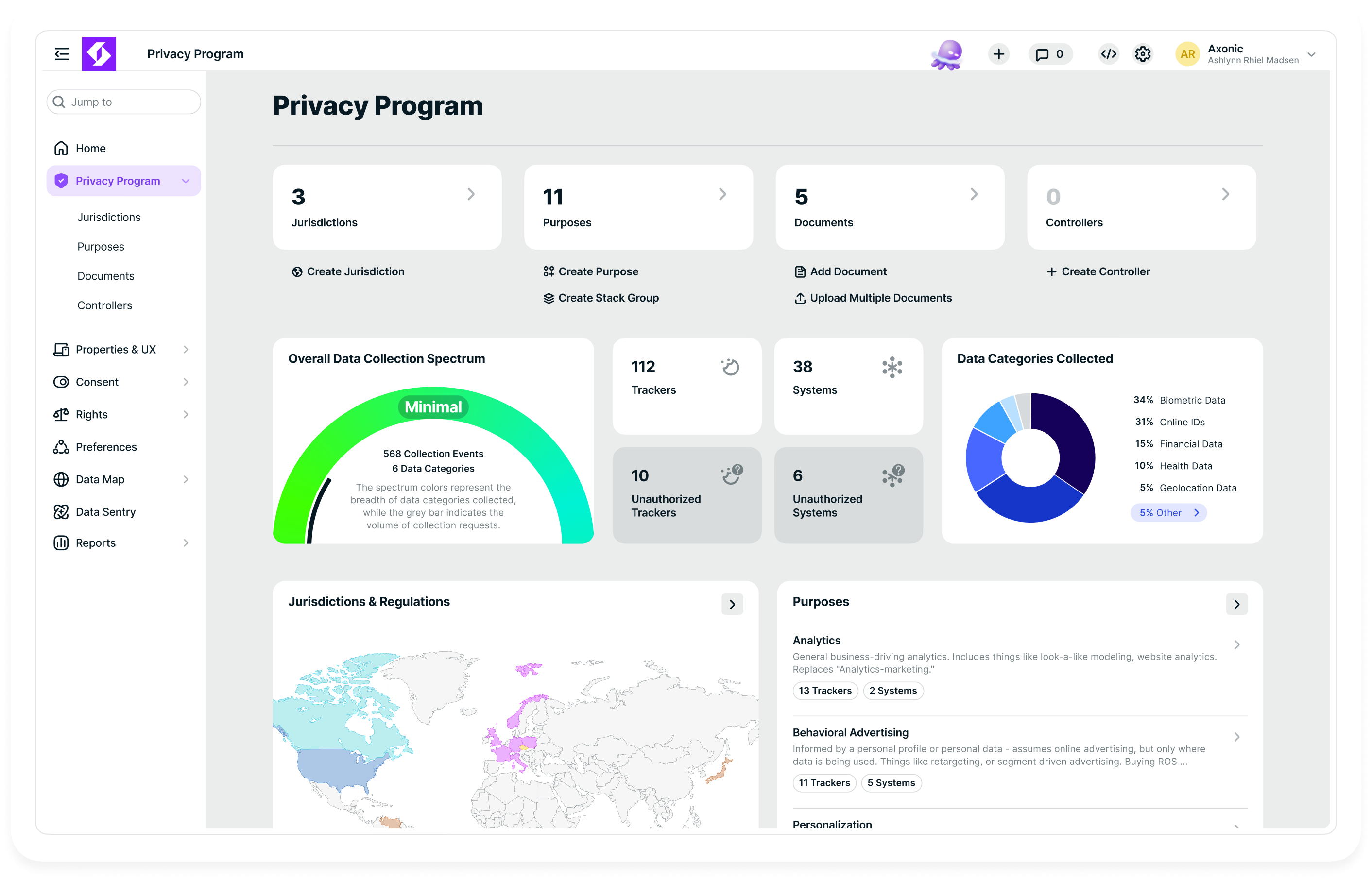
Ketch was built differently. It is an integrated permissioning layer that connects website data collection, consent and rights signals, consumer identities, data systems, third party applications, policies, and assessments into a single platform.
That architectural difference is why Ketch doesn’t map cleanly to competitors.
Some privacy vendors offer broad portfolios of products across consent, rights, and governance. But breadth alone doesn’t create a platform.
When those products aren’t created with foundational elements like identity synchronization and system orchestration, development and engineering efforts fall to the customer. Consumer choices become disconnected, enforcement becomes manual, and complete auditability and traceability becomes impossible, all while complexity grows.
Replacing Ketch with “alternatives” usually includes point tools, homegrown solutions, and manual options (like email and spreadsheets), while relying on engineers and developers to stitch everything together.
Ketch alternatives by capability area
Most tools compared to Ketch compete on individual capabilities. Ketch competes on whether privacy actually works across the business.
During vendor evaluations, organizations naturally compare vendors by function: consent, rights fulfillment, data mapping, or assessments. That’s how most privacy software is sold, and it’s a reasonable starting point.
But capability checklists miss the harder problem: execution across systems, identities, and teams.
Modern privacy requires more than collecting consent signals and rights requests. It requires configuring synchronizing choices across every touchpoint, enforcing choices and policies inside data systems, and producing proof on demand during an investigation.
Ketch privacy capabilities are natively integrated into a single platform so discrete products like consent, data subject rights, and assessments work better together.
The sections below reflect how organizations typically evaluate alternatives by capability area, and why those tools often solve adjacent tasks rather than running privacy end to end.
1. Consent management platforms (CMPs)
What they do well: Collect consent signals on websites and apps.
Most CMPs are effective at displaying banners and capturing privacy choices at the point of interaction. For most organizations, deploying a consent or cookie banner is the first step towards meeting privacy requirements.
Here are some common CMP alternatives teams evaluate versus Ketch:
- OneTrust: An enterprise privacy and consent management platform offering consent banners, preference management, and compliance workflows across regions and regulations.
- TrustArc: A privacy management platform providing consent management, regulatory assessments, and compliance reporting for global privacy programs.
- Transcend: A privacy infrastructure platform focused on consent management and developer-centric privacy workflows, often requiring engineering involvement for downstream enforcement.
Most CMPs fail to send consent signals everywhere data is stored. This results in incomplete enforcement of consumer data sharing preferences.
Most CMPs store consent choices in the browser (client side). They fail to store choices server side. This brittle architectural decision makes it impossible to maintain a central source of truth for consumer identity resolution, and orchestration of choices to data systems and apps.
As a result, consent is captured, but not consistently honored or provable across systems.
That gap has real consequences. In its €50 million GDPR fine against Google, France’s CNIL cited invalid consent and the inability to demonstrate meaningful enforcement across systems.
What Ketch does differently: Ketch takes a fundamentally different approach. After consent signals are collected, they are stored server-side in the Ketch Permission Vault: the server-side, authoritative source of truth for every consent and permission your business holds, for both logged-in and anonymous users.
Using a native identity framework, Ketch synchronizes a person’s choice across all touchpoints—devices, browsers, data systems, applications, and partners—automatically and in real time.
Consent doesn’t just exist in a banner. It propagates everywhere it needs to, with enforcement and auditability built in.
Read further: Ketch Consent Management Platform
2. DSAR and rights fulfillment tools
What they do well: Basic intake forms and manual task routing.
Most DSAR tools are designed to intake consumer requests, route tasks and to-do’s to relevant stakeholders (e.g. via email alerts), and provide a log of open requests.
Here are some common DSAR and rights fulfillment alternatives teams evaluate versus Ketch:
- DataGrail: A privacy operations platform focused on DSAR intake, fulfillment workflows, and regulatory reporting across common SaaS and data systems.
- Transcend: A privacy infrastructure platform offering DSAR automation through integrations, often requiring engineering involvement for customization.
- OneTrust: An enterprise privacy platform providing rights request management, workflow tracking, and compliance reporting.
Where these tools struggle is fulfillment at scale.
Most DSAR tools stop at ticketing and task alerting. Humans are still responsible for finding data across systems, deleting or exporting it, validating results, and confirming completion. As volumes grow, manual steps introduce delays and errors.
Regulators increasingly penalize this approach. Under CPRA, enforcement actions have cited delayed, incomplete, or obstructive rights request handling. In 2025, the California Privacy Protection Agency fined American Honda Motor Co. over request workflows that made it harder for consumers to exercise their rights, and the California Attorney General announced a $1.55 million penalty with Healthline Media tied to failures to honor opt-out and privacy control signals in practice.
These cases signal that regulators are scrutinizing not just whether requests are accepted, but whether the process is frictionless and prompt.
What Ketch does differently: Ketch fulfills rights requests through direct system integrations, automating data discovery, retrieval, deletion, and confirmation. Human bottlenecks are removed, and responses remain accurate as complexity grows.
This matters when regulators evaluate response quality, not just speed.
Read further: Ketch DSR automation
3. Data mapping and RoPA tools
What they do well: Document processing activities.
Data mapping and RoPA tools help organizations inventory systems, document data flows, and satisfy record-keeping requirements. They’re often used to prepare for audits or assessments.
Here are some common data mapping and RoPA alternatives teams evaluate versus Ketch:
- BigID: A data intelligence platform specializing in large-scale data discovery, classification, and inventory across structured and unstructured data. OneTrust: Offers data mapping and RoPA documentation tools tied to assessments and compliance workflows.
- TrustArc: Provides data inventory management and records of processing support for regulatory reporting.
Where these tools struggle is staying accurate over time.
Most rely on surveys, workshops, or point-in-time scans. As systems change, records drift out of sync with reality. Under Article 30 of the GDPR, organisations must maintain up-to-date records of processing activities (RoPA) and make them available to supervisory authorities upon request, reflecting the actual data processing operations carried out by the business.
European regulators regularly request RoPA during compliance audits or investigations, and failure to produce accurate, current records, or producing outdated/inaccurate RoPA, can be treated as failing to meet GDPR accountability obligations, which may trigger deeper investigation and enforcement action by a national supervisory authority.
What Ketch does differently: Ketch keeps data maps current by design. Live system integrations ensure policies reflect how data is actually collected, used, and shared—without manual upkeep.
Auditors see reality. Teams avoid surprises.
Read further: Ketch Data Mapping
4. Marketing preference management
What they do well: Capture subscription and communication choices.
Marketing preference tools help customers opt in or out of emails, SMS, and other communications. They give teams a way to collect preferences and demonstrate respect for customer choice.
Here are some common marketing preference and subscription management alternatives teams evaluate versus Ketch:
- OneTrust: Offers preference centers and consent storage tied to compliance workflows.
- Osano: Provides consent and preference management focused on marketing compliance use cases.
- TrustArc: Supports preference capture and communication choices as part of broader privacy tooling.
Where these tools struggle is consistency and activation.
Preferences are often stored in isolated systems and applied unevenly across ESPs, CRMs, CDPs, and internal tools.
Customers unsubscribe in one place but continue receiving messages from another. Marketing teams patch gaps manually, engagement drops, and compliance risk grows.
What Ketch does differently: Ketch gives marketers a single source of truth for customer preferences. Customers choose once, and that choice flows automatically across systems, brands, regions, and channels.
Preferences are stored server-side, permissioned, and immediately actionable inside ESPs, CRMs, and CDPs. Campaigns run on trusted first-party data, personalization improves, and brand trust grows, without slowing teams down with services-heavy implementations.
Preferences aren’t just collected. They’re enforced, activated, and auditable.
Read further: Ketch Marketing Preferences
5. Website and cookie scanning
What they do well: Identify cookies and tracking technologies.
Cookie scanning tools help detect cookies, pixels, and trackers on websites. They’re commonly used to populate cookie disclosures and support banner configuration.
Here are some common cookie scanning alternatives teams evaluate versus Ketch:
- Privado: A privacy engineering platform with strong capabilities for detecting cookies, SDKs, trackers, and data collection in apps and websites.
- OneTrust: Offers widely used cookie scanning and classification tied to CMP workflows.
- Osano: Provides automated cookie scanning and categorization focused on compliance reporting.
Where these tools struggle is understanding data use, not just cookies.
Traditional scanners identify what loads in the browser, but they stop short of showing what data is actually sent, where it goes, and how it’s used downstream. They don’t cover things like sensitive data flows, tracker lineage to identify piggybacking issues, or third-party destinations beyond the page.
What Ketch does differently: Ketch goes beyond cookie scanning with Data Sentry, which verifies real data flows, not just page tags.
Data Sentry monitors what data is actually sent—not just what scripts exist. It provides visibility into real data flows across client-side and server-side contexts, helping teams detect leakage, misconfiguration, and policy violations that cookie scanners can’t see.
Cookies are just the surface. Ketch shows what’s happening underneath, with enforcement and auditability built in.
Read further: Ketch Data Sentry
6. Vendor risk and privacy assessments
What they do well: Standardize questionnaires and documentation.
Vendor privacy tools help assess third parties through questionnaires, scoring, and supporting documentation. They bring consistency and structure to an otherwise manual vendor review process.
Here are some common vendor risk and privacy assessment alternatives teams evaluate versus Ketch:
- OneTrust: A widely used platform for vendor risk management, privacy assessments, questionnaires, and compliance workflows.
- TrustArc: Offers third-party privacy assessments, risk scoring, and regulatory documentation.
- DataGrail: Provides vendor management features focused on privacy risk and third-party disclosures.
Where these tools struggle is enforcement and auditability.
Assessment results often live in isolation. Approved vendors may still access data in ways that exceed stated permissions, and there is limited evidence tying assessment outcomes to actual data use. During breach investigations and regulatory inquiries, this gap becomes visible—and costly.
What Ketch does differently: Ketch links vendor permissions directly to policy enforcement and audit logs. Approved use, restricted use, and opt-outs are enforced in real systems, and every action is recorded in a verifiable audit trail that can be produced on demand.
Vendor approval isn’t just documented. It’s provable.
Read further: Privacy 360 Analytics Suite: audit-ready reporting for modern privacy enforcement
7. Privacy, AI governance, and future use cases
What they do well: Provide guidance.
Many privacy and AI governance tools focus on documentation, review boards, and internal guidelines. They help organizations define acceptable use.
Here are some common privacy and AI governance alternatives teams evaluate versus Ketch:
- Privado: A privacy engineering platform focused on identifying and governing personal data use in applications, including AI and analytics contexts.
- BigID: Offers data intelligence and classification capabilities that support AI governance and sensitive data controls.
- OneTrust: Provides AI governance documentation, assessments, and policy frameworks.
Where these tools struggle is execution.
Most AI governance solutions document intent but don’t control data access. Enforcement remains manual, making it difficult to prove how data was—or wasn’t—used in models and automated decisions.
What Ketch does differently: Ketch applies machine-readable privacy policies at the data layer. This makes AI governance enforceable, auditable, and adaptable as regulations evolve.
Privacy rules don’t just guide behavior. They control it.
Read further: AI Governance
Ketch vs. other privacy platforms
Traditional privacy platforms were built for a simpler, compliance-first era of privacy. They focus on inventories, questionnaires, assessments, and workflows that sit outside the systems where data is actually collected and used.
That model can work if the business is satisfied with periodic, static exercises as a means to gauge risk. In today’s data-rich, data-driven businesses, it’s often inadequate, and immediately out of data, leaving privacy leaders in the dark and vulnerable to inquiry or investigation.
Regulators increasingly ask questions that documentation alone can’t answer: how consent was enforced across systems, how a deletion actually propagated, or how restricted data was prevented from being used in analytics or AI models. At that point, a written policy or dated inventory simply isn’t enough.
Legacy platforms help teams prepare documentation. Ketch treats privacy as a live data control problem that requires real-time monitoring, orchestration, and logging. When audits and inquiries happen, the proof of compliance is already available in Ketch.
In the 2026 Gartner® Magic Quadrant™ for Privacy UX, Ketch was named a Leader, positioned highest for ‘Ability to Execute’ and furthest for ‘Completeness of Vision’. Read the report.
Why organizations choose Ketch
Simple reason: They want modern privacy tech that is purpose-built for compliance with today’s regulatory requirements.
Most privacy programs don’t fail because teams lack intent. They fail because privacy depends on manual work, fragile integrations, and a few people holding everything together.
Organizations choose Ketch when:
- Engineering teams can’t keep absorbing privacy work, custom integrations, and last-minute changes without slowing product delivery.
- Legal teams need provable compliance on demand, with clear evidence showing how consent, rights, and policies were enforced across systems.
- Marketing teams want trust-driven growth, using clean first-party data and transparent preferences instead of dark patterns or fragmented tools.
- Data and AI teams need consistent, enforceable rules governing how data can be used, shared, or restricted as analytics and AI use cases expand.
In practice, Ketch becomes the system that removes friction from privacy operations:
- Decisions execute automatically across systems.
- Proof is generated by default, not assembled later.
- Teams stop relying on heroics to stay compliant.
What actually differentiates Ketch
Ketch turns privacy into a configurable system, not a custom engineering project.
Most privacy programs slow down because every change requires code, services, or one-off fixes. That friction grows as regulations evolve, systems multiply, and more teams depend on privacy decisions.
Ketch was designed to remove that friction by making privacy operational, enforceable, and adaptable by configuration.
Key differentiators include:
- Click-based configuration, not code: Privacy workflows are deployed through an intuitive interface—no engineering backlogs, no consultants, and no custom builds. Teams can adapt policies as requirements change without waiting on releases.
- Cross-device identity synchronization: A person’s preferences are resolved once and applied everywhere. Ketch synchronizes choices across devices, browsers, systems, and channels using a native identity framework, eliminating gaps and inconsistencies.
- On-demand proof: Every privacy action produces a time-stamped, verifiable audit log automatically. Proof isn’t assembled later—it exists by design, ready for regulators or legal inquiries.
- Marketing and growth enablement: Ketch unifies privacy and marketing by turning consent and preferences into trusted first-party data. Progressive consent and zero-party capture improve engagement without compromising compliance.
- Enterprise flexibility: Complex organizations rarely solve privacy the same way everywhere. Ketch supports multiple workflows and enforcement paths to fit different teams, regions, and data architectures—without breaking consistency.
Instead of slowing the business down, Ketch lets privacy operate at the speed of the company—reliably, provably, and at scale.
“With Ketch, we can actually say what we do, and do what we say. We’re being transparent with our visitors about our data policies, and we’ll honor their choices by using Ketch to send those consent signals downstream across our marketing techstack.”
Jake Kimball, Director of Marketing Operations, Questex
Still evaluating? How to compare platforms the right way
Due diligence should focus on whether a platform can remember, enforce, and prove privacy decisions everywhere your data lives.
Feature lists won’t tell you that. Documentation won’t either. The only way to understand how a privacy platform really works is to see how decisions flow, from consent and rights requests into real systems, with proof generated automatically.
If you’re comparing Ketch to other privacy platforms, the goal isn’t pressure. It’s visibility.
See how Ketch compares in practice:
- How consent is synchronized across systems and devices
- How rights requests are fulfilled end to end
- How policies are enforced inside data, marketing, and AI systems
- How audit logs are generated instantly, without manual effort
Start an interactive tour to see how Ketch runs privacy, from collection to enforcement to proof.
If you want a closer look, you can also book a demo and we’ll tailor it to your team’s systems, workflows, and regulatory requirements.
No pressure. Just a clear view of how the platform actually works.
Compare further: The Best Enterprise Data Privacy Softwares to Watch
Download Now: Your No-BS Guide to choosing Privacy Software


