


Tags
Read time
8 min read
Last updated
May 19, 2026
Ketch makes consent banner set-up a breeze with drag-and-drop tools that match your brand perfectly. Let us show you.

The best enterprise consent management platforms in 2026 enforce consent where data actually flows, not just where it's collected. There is one architectural divide that separates the platforms on this list: whether consent is stored server-side or browser-side. Ketch is the only platform here built server-side from the ground up, with real-time propagation across CDPs, ad pipelines, and AI infrastructure. OneTrust and Usercentrics cover broad regulatory and programmatic needs. Sourcepoint and Didomi specialize in IAB TCF and adtech consent. Transcend serves developer-led teams. Osano fits earlier-stage programs.
Most "best consent management platform" articles are written by vendors who rank themselves first and grade their competitors not so generously. We're a vendor. We know how this looks.
Here's the deal: Ketch appears on this list, and we think we’re the strongest option for enterprise use cases. We're transparent about that. But the evaluation criteria in this guide come from real RFPs, real sales conversations, and real gaps that show up when CMPs fail, not from a marketing brief.
The goal is a guide that's genuinely useful, even if you don't choose Ketch. There's a meaningful difference between the platforms here, and you deserve to know what it is before you sign a contract.
One note on scope: this guide covers consent management platforms specifically: the software that governs how consent is collected, stored, and enforced across digital properties and data systems. If you're evaluating the broader privacy software landscape – data discovery, DSAR automation, etc, Ketch has a separate guide for that: Best data privacy software.
The cookie banner era created a category of tools optimized for one job: display a notice and log a choice. That was enough when regulators were still writing enforcement playbooks.
It is no longer enough.
Jam City, a mobile gaming company, paid $1.4 million to the California AG for failing to process opt-out preferences in data sales and ad monetization, and for mishandling minor data permissions. The consent collection existed. The enforcement into the ad pipeline didn't.
Solocal Marketing Services paid €900,000 to France's CNIL for commercial data prospecting without consent and for transferring personal data to partners without a lawful basis. The consent program wasn't connected to the partner data flows.
Orange paid €50 million to the CNIL for a system that kept reading cookies after consumers withdrew consent. Real-time enforcement failure, at scale, at a major telco.
The pattern across all three: the companies had banners. They had policies. But the consent signal stopped at the browser and never reached the systems where data actually moved.
That gap – between consent collection and consent enforcement – is now the central evaluation question for enterprise CMPs in 2026. Add AI training pipelines to the surface area, and the gap gets expensive fast.
Nine criteria. Each one maps to a question privacy, marketing, and legal leaders actually ask during a CMP evaluation.
Best for: Enterprises that need consent enforced everywhere data flows – not just collected at the banner – with CDP propagation, zero-party data activation, and AI permission governance in a single server-side permissioning infrastructure.
Ketch is the #1 ranked consent management platform on Gartner Peer Insights (4.9/5) and a G2 Grid Leader for Enterprise (Spring 2026, 4.6/5 across 120+ reviews). It processes 67.2 billion consent transactions per month across 3,500+ businesses including LVMH, Paramount, Equifax, Forbes, Chipotle, Hasbro and more. Ketch is a Google Certified CMP Partner as well.
What separates Ketch architecturally from every other platform on this list: most CMPs are built to collect consent at the browser and store a record. Ketch is built to enforce it everywhere data goes. That difference shows up in every criterion below.
Ketch Consent Management supports GDPR, CCPA/CPRA, LGPD, PDPA, Quebec Law 25, and all other prominent frameworks found across the globe from a single platform.
It offers 400+ no-code configurations for frontend privacy experiences — banner layouts, modal styles, preference centers, progressive consent flows — without engineering tickets.
A real-time WYSIWYG editor means privacy and marketing teams can test and deploy without waiting on developers.
Ketch Permission Vault is a server-side consent database – not a browser cookie, not localStorage, not a client-side script. It is the authoritative record of every consent decision made across every touchpoint, stored centrally and independently of any browser session or device.
This is the architectural foundation for everything else Ketch does: downstream enforcement, cross-device persistence, AI pipeline governance, and audit-ready receipts.
No amount of configuration makes browser-based storage do what a server-side consent store does natively.
Because Permission Vault is server-side, it pushes consent signals in real time to every downstream system – CRM, CDP, email platform, ad network, data warehouse – without browser dependency.
Ketch Opt-Out Sync orchestrates enforcement across all connected systems with no delays and no page reloads. Native integrations include Salesforce, Segment, and Braze.
Ketch Data Sentry monitors real-time network traffic to verify consent is actually being honored downstream. In documented enterprise deployments, Data Sentry found 76% of data collection events were not authorized post opt-out – the gap between what a CMP records and what actually happens in the data pipeline.
Most enterprise privacy stacks have a structural gap that rarely gets named in vendor evaluations: the CMP and the DSR system don't talk to each other.
The CMP controls browser-side tracking – cookies, tags, pixels. The DSR system handles opt-out requests tied to known identities – email addresses, backend records.
"The industry has spent years adding more banners and forms, while opt-out enforcement remained fragmented behind the scenes."
- Max Anderson, Head of Product and Co-Founder at Ketch
In most organizations these run independently, meaning a consumer has to opt out in two places to actually be opted out everywhere. Regulators have treated this consumer burden as a compliance failure, subject to enforcement and fines.
Ketch Opt-Out Sync closes that gap. A consumer opt-out, whether collected through a banner or webform, is captured once and automatically enforced across both layers: browser-side tracking and backend systems. Identity-based audit receipts confirm where and when each opt-out was applied.
Permission Vault resolves consent to the person, not the device. It unifies cookies, mobile IDs, authenticated identifiers, and system records into a single person-level consent record.
When a consumer switches browsers or devices, their consent state follows them. This is the identity resolution capability regulators expect when they ask whether a consumer's opt-out was actually honored everywhere, not just in the browser where it was captured.
Ketch supports IAB TCF 2.2, Global Privacy Control (GPC), and Google Consent Mode v2 natively. As a Google Certified CMP Partner, Ketch transmits consent signals directly into the Google ecosystem, ensuring that ad measurement, audience targeting, and conversion tracking in Google Ads and GA4 reflect actual consent status in real time.
For publishers and advertisers managing programmatic consent, Ketch handles vendor list management, purpose-based consent, and signal transmission to DSPs and SSPs within the standard framework.
Ketch's publisher customer base — Forbes, TIME, Paramount, The Globe and Mail, AMC Networks, and others — reflects consent programs that go well beyond TCF: subscriber identity, cross-device enforcement, first-party data activation, and AI pipeline governance, all governed through a single server-side permissioning layer.
Read more: Privacy frameworks
Ketch Marketing Preference Management moves consent from legacy opt-in/opt-out to progressive permissioned profiling.
It builds declared preference profiles – communications frequency, content interests, personalization settings, channel preferences – and feeds them directly into marketing activation systems.
According to Ketch, 82% of consumers are concerned about how their data is gathered and used. But 81% see value in sharing data with brands in exchange for benefits.
Ketch captures and activates that second number. In one documented deployment, A/B testing consent experience variants produced an 18% improvement in opt-in rates over the baseline.
The consent moment stops being a legal wall and starts being a first-party data asset.
Ketch AI Sentry is the only purpose-built AI permission layer on this list. It continuously monitors AI activity, detects unapproved data flows, enforces consent and rights signals at every LLM interaction, and logs every AI action for governance demonstration.
When an AI model attempts to process data from a consumer who has withdrawn consent, AI Sentry flags and blocks it.
The Ketch Transponder classifies data and data processing across systems inside the customer's own environment – without extracting raw data externally – making it viable for organizations with strict data residency requirements.
Every consent event captured by the Ketch CMP flows into the Permission Vault and governs AI data pipelines in real time. Consent collected today determines what data an AI model is permitted to train on tomorrow.
For enterprises building AI products, this turns the CMP from a compliance cost into a data infrastructure investment.
Ketch Smart Tag loads asynchronously using a deferred execution model. The script runs only after the document has parsed, so it never sits in the critical rendering path.
Combined with globally distributed infrastructure, advanced caching, and just-in-time JavaScript that loads only what each session needs, Ketch is engineered to leave Core Web Vitals – FCP, LCP, and TBT – measurably intact.
For performance-sensitive properties in retail, media, and publishing, this is a meaningful architectural distinction from legacy CMPs that load synchronously and block page rendering until the consent script completes.
Every capability in this section follows from one architectural decision: storing consent server-side in Permission Vault rather than in the browser.
That single choice is what makes real-time downstream enforcement possible, what makes CMP and DSR systems share a single opt-out workflow, what makes person-level cross-device persistence possible, what makes AI pipeline governance possible, and what makes the audit trail defensible when regulators ask for proof.
A browser-based CMP cannot retrofit any of this. It is a foundation problem, not a configuration problem.
Ketch connects legal, marketing, engineering, and data teams in a single platform. Organizations operating in silos may see slower initial adoption until stakeholders align on who owns what but Ketch's implementation team helps speed up the process where possible.
The platform offers multiple configuration paths to solve the same problem, powerful, but different from rigid template-only tools until teams settle on their preferred approach.
G2: 4.6/5 (120+ reviews) | Gartner Peer Insights: 4.9/5 | Example customers: LVMH, Paramount, Equifax, Forbes, Chipotle, Hasbro

Go further: Ketch Alternatives: Why There Is No Exact Substitute

Best for: Large enterprises with dedicated teams and resources that want a single GRC-style vendor spanning consent, DSAR workflows, vendor risk, and compliance documentation — and are willing to configure downstream enforcement separately.
OneTrust is the largest legacy privacy management vendor by headcount and revenue. Its consent management module is one part of a much broader platform that also covers data mapping, vendor risk management, DSAR automation, and ESG. For procurement teams that want one contract for all privacy functions, OneTrust is the default starting point.
OneTrust supports GDPR, CCPA, and 300+ global data privacy laws with geo-targeting for jurisdictional banner variations. Banner configuration is module-based and covers most standard use cases.
Client-side consent scripts can introduce page-load latency on high-traffic or tag-heavy sites — a trade-off to evaluate for performance-sensitive properties.
OneTrust stores consent browser-side by default, in cookies and client-side scripts. Server-side storage is available as an additional configuration but is not the platform's default architecture.
The practical consequence is that consent records live in the browser until explicitly elevated to a server-side store, meaning downstream enforcement, cross-device persistence, and audit completeness all depend on work done on top of the default setup rather than on it.
OneTrust integrates with major CDPs and marketing platforms through API connections and a partner ecosystem. Consent signal propagation downstream varies by implementation and connector configuration.
Server-side enforcement is not the default architecture. It requires additional setup compared to platforms built server-side from the ground up. Complex deployments often need consultant support or ongoing engineering maintenance.
OneTrust has both a consent management module and a DSR module, but they operate as separate products within the platform rather than as a unified opt-out enforcement workflow.
Connecting them to produce a single opt-out action that governs both browser-side tracking and backend identity records requires configuration work and, in complex deployments, professional services.
A consumer submitting a "Do Not Sell" request through OneTrust's DSR module does not automatically trigger enforcement across the CMP layer – and vice versa.
Organizations evaluating OneTrust for end-to-end opt-out compliance should explicitly map how the two modules communicate and what consumer actions are required in each.
Consent is stored browser-side by default in OneTrust, meaning it does not follow the consumer across devices or browsers without additional identity resolution configuration.
A consumer who opts out on mobile may still be targeted on desktop if that cross-device signal is not explicitly reconciled through supplemental identity work.
This is not a configuration edge case – it is the default behavior of browser-scoped consent storage, and regulators have treated device-specific opt-out failures as compliance violations.
Read further: The real lessons of the Disney CCPA settlement
IAB TCF 2.2 is supported, and OneTrust is a Google Certified CMP Partner with Google Consent Mode v2 integration. Programmatic advertising consent use cases are covered, though TCF-specialist platforms carry more depth in the publisher/adtech stack specifically.
OneTrust Preference Management captures communication and marketing preferences with portal-based experiences.
The positioning skews compliance-oriented rather than marketing activation–oriented compared to platforms built specifically for zero-party data use cases.
OneTrust has added AI governance modules including AI inventory and risk assessment. Enforcement of consent signals into AI training pipelines is an evolving capability. Evaluate the depth of real-time enforcement versus documentation-and-audit functions, they're not the same thing.
OneTrust's client-side consent scripts are known to load synchronously in certain configurations, meaning the browser pauses rendering until the script finishes executing.
This increases Total Blocking Time and delays First Contentful Paint, with measurable impact on bounce rates and conversion rates for high-traffic properties.
The performance cost varies by implementation, but it is a documented risk rather than a hypothetical one. Test Core Web Vitals against your specific setup before deployment.
G2: 4.3/5 | Example customers: Samsung, IBM, Pfizer, Atlassian
Read further:
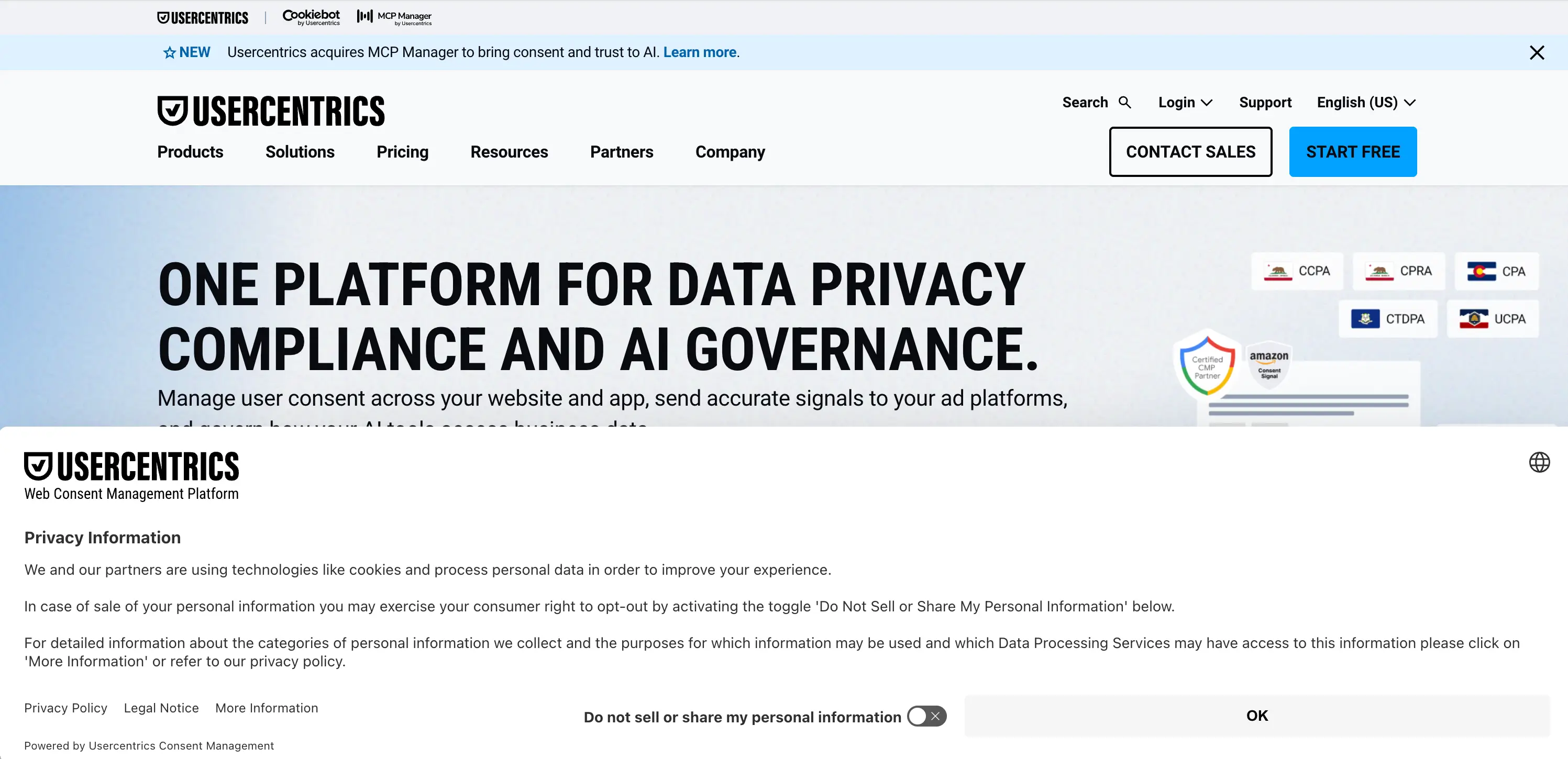
Best for: European-market companies and publishers needing fast TCF deployment, strong GDPR compliance, and Google-certified banner implementation.
Usercentrics is a German-founded CMP widely deployed across European markets. Its core strength is GDPR and IAB TCF 2.2 compliance, and it is a recognized Google Certified CMP Partner.
For organizations whose primary consent challenge is European web consent and programmatic advertising compliance, Usercentrics deploys quickly and covers the standard requirements.
Usercentrics covers GDPR, CCPA, and LGPD with pre-built consent templates and a script-based implementation. Customization is available through its UI.
Setup is generally faster than enterprise-heavy platforms, which makes it popular with teams that need rapid compliance coverage.
Usercentrics stores consent browser-side via a client-side JavaScript snippet. There is no server-side consent store in the platform's native architecture.
Consent records are scoped to the browser session in which they are captured, they are not stored in a central database that downstream systems can query or that produces audit-ready receipts independent of the browser.
Usercentrics offers pre-built integrations with major marketing and analytics tools. Downstream enforcement depth depends on the integrations selected.
The platform focuses primarily on front-end consent collection, enforcement beyond the browser requires integration work.
Usercentrics is a CMP. It does not include a native DSR module. Organizations using Usercentrics need a separate DSR tool to handle "Do Not Sell" and opt-out requests tied to known identities – and must build or configure the bridge between the two themselves.
There is no native workflow that connects a banner opt-out with backend identity-based enforcement. A consumer who opts out through the Usercentrics consent banner and separately submits a DSR form is submitting two independent requests to two unconnected systems.
Cross-device enforcement and server-side consent storage are not default capabilities in Usercentrics. Consent choices are tied to the browser or session where they are captured.
If a consumer opts out on one device and returns on another, that preference is not automatically carried across without additional engineering work.
For organizations whose consumer base moves fluidly between desktop, mobile, and app environments, this is a material enforcement gap.
This is Usercentrics' strongest ground. TCF 2.2 support is comprehensive, with vendor list management and purpose-based consent signals that transmit to programmatic advertising partners.
Usercentrics is a Google Gold CMP Partner and supports Google Consent Mode v2, making it a capable option for organizations whose primary consent challenge is GDPR and TCF compliance within the Google ad ecosystem.
For organizations managing large vendor lists in a TCF context, Usercentrics handles the standard workflows well.
Preference management is available as extended consent options. It is not positioned as a declared-data marketing activation layer, the depth of preference profiling stays closer to communication preferences than progressive zero-party data capture.
Not a primary capability area as of this writing.
Usercentrics delivers consent via a client-side JavaScript snippet. Performance impact depends on how the script is loaded and how many services are configured in the consent layer, both of which can introduce render-blocking behavior.
No published architecture claims distinguish its loading model from standard client-side CMP behavior. Benchmark Core Web Vitals before deployment on any performance-sensitive property.
G2: 4.5/5 | Example customers: Lufthansa, Douglas, About You
Read further: Ketch vs Cookiebot
Best for: Adtech-focused organizations whose primary consent challenge is IAB TCF compliance for programmatic advertising, and whose consent requirements don't extend significantly beyond that stack.
Sourcepoint built its reputation in the programmatic advertising ecosystem. Its consent management platform integrates with DSPs, SSPs, and DMP connections that map directly to TCF vendor relationships. For organizations whose consent program begins and ends at the ad stack, Sourcepoint covers that ground.
Sourcepoint supports GDPR and CCPA with geo-targeting and A/B testing capabilities for consent experiences.
It is a Google Certified CMP Partner. Configuration for adtech-adjacent use cases — paywalls, messaging, consent-or-pay models — is more developed here than in general-purpose CMPs.
Sourcepoint stores consent browser-side. Its architecture is optimized for transmitting TCF signals to DSPs and SSPs — not for maintaining a central, queryable consent record across enterprise systems.
There is no native server-side consent store that governs downstream data pipeline enforcement or produces system-level audit receipts.
Sourcepoint's integration depth is strongest within the adtech stack. It does not extend natively to enterprise marketing CDPs, CRMs, email platforms, or data warehouses.
Publishers managing first-party subscriber data, audience segments, or loyalty programs alongside advertising consent will find the adtech-first architecture covers only one part of their consent surface area.
Sourcepoint does not include a DSR module. It is a CMP built for the programmatic advertising stack, and opt-out enforcement does not extend to backend identity records, known-user data, or "Do Not Sell" request processing.
Organizations using Sourcepoint need a separate DSR system, and any connection between the banner opt-out layer and backend enforcement is entirely outside Sourcepoint's scope.
Sourcepoint does not offer native identity resolution across devices or browsers. Consent choices are captured in the web session context and do not automatically reconcile across a consumer's other devices or authenticated environments.
For publishers managing reader consent across web, app, and logged-in experiences, this creates an enforcement gap that requires identity infrastructure built entirely outside Sourcepoint.
TCF 2.2 vendor management and programmatic signal transmission are Sourcepoint's strongest capabilities.
Sourcepoint is a Google Certified CMP Partner and supports Google Consent Mode v2 within its adtech-focused architecture.
For organizations whose primary consent use case is managing vendor consent for programmatic advertising, this is where Sourcepoint is most competent.
Not a primary capability. Preference management is oriented toward messaging preferences and consent choices within the ad context — not declared marketing preference profiling or zero-party data activation.
Not a primary capability area as of this writing.
Sourcepoint delivers consent via client-side scripts. No published architecture claims distinguish its loading model from standard client-side CMP behavior.
For publishers where ad viewability and page speed are directly tied to revenue, the performance cost of a render-blocking consent script is a real operational risk.
Benchmark FCP, LCP, and TBT against your specific configuration — do not assume adtech-scale usage implies performance optimization.
Sourcepoint's architecture is purpose-built for the programmatic advertising stack. Outside that context – subscriber data management, CDP integration, cross-device compliance, first-party data activation, AI data governance – it is not architected to deliver.
Publishers operating full-stack consent programs, not just ad monetization consent, should evaluate whether a specialist adtech CMP covers their full surface area or creates a second consent infrastructure problem alongside it.
Didomi and Sourcepoint joined forces in July 2025. Sourcepoint's product roadmap and strategic direction are now partially governed by Didomi. Organizations evaluating Sourcepoint for a multi-year deployment should assess what that partnership means for the platform's independence, pricing, and feature prioritization over time.
G2: Not widely reviewed for enterprise | Example customers: Adtech and programmatic advertising–focused publishers
Best for: Developer-first organizations that want to embed consent and privacy enforcement programmatically into their data pipelines.
Transcend takes an API-first, infrastructure-native approach to consent and privacy management. It is built for engineering teams. The interface, the configuration model, and the integration approach all assume developer resources are available and engaged.
Transcend provides consent banner capabilities alongside its broader privacy infrastructure functions. Customization is deep but developer-dependent. Non-technical teams can require additional resources as there is less self-service configurability than in UI-first platforms.
Transcend does not provide a native server-side consent store equivalent to Ketch’s Permission Vault. Consent for anonymous users is handled browser-side.
For authenticated users, consent can be associated with an identity through developer-built connections to backend systems – but this requires custom engineering rather than a platform-native capability.
There is no central consent database that automatically receives, persists, and distributes consent decisions across all connected systems out of the box.
Transcend connects directly to databases, data warehouses, CDPs, and SaaS tools at the code level – suited to engineering teams that want consent enforcement wired into the data pipeline.
Downstream enforcement beyond the browser, into advertising platforms, analytics tools, and partner systems, depends on customer-built integrations rather than native connectors.
Transcend has both CMP and DSR capabilities. Integration between them is possible, but it requires custom engineering rather than a native unified workflow.
Transcend's API-first model means the bridge between a banner opt-out and backend DSR enforcement is something engineering teams build and maintain, not something the platform delivers out of the box.
For developer-led organizations with dedicated engineering capacity, this is workable. For privacy or legal teams expecting a product-native opt-out sync, it is a gap that depends on ongoing engineering resources to remain functional.
For logged-in users, Transcend can associate consent choices with an authenticated identity. For anonymous or unauthenticated users – the majority of web traffic – consent is handled at the browser or session level.
A consumer who opts out anonymously on mobile and returns on desktop starts with a clean slate. There is no server-side consent store that persists choices at the person level across contexts without additional custom engineering. This is a structural constraint, not a configuration gap.
IAB TCF 2.2 support is available. Google Consent Mode v2 integration is not prominently documented as a native capability, organizations requiring GCM v2 for Google Ads or GA4 consent signalling should verify current support directly with Transcend.
Not a TCF specialist in the way Ketch, Sourcepoint or Usercentrics are.
Preference management is available with consumer-facing preference centers. The depth of marketing activation use cases is limited compared to platforms built specifically for zero-party data growth. Engineering teams can build this out, but it requires resources.
Transcend has no equivalent to Permission Vault — there is no persistent, person-level consent store that natively feeds AI pipelines with permissioning signals.
Governing AI data use requires custom-built logic on top of the platform.
Transcend's performance outcomes depend entirely on how engineering teams implement the consent layer. There is no default async or deferred loading architecture, performance is as good or as poor as the custom code written to deliver it.
For teams without dedicated engineering capacity, that means performance risk goes unmanaged. Benchmark Core Web Vitals against your specific implementation; do not assume developer flexibility translates to developer execution.
Non-technical privacy and marketing teams will face a steeper learning curve. Transcend is strong when engineering owns the privacy program. It is harder to recommend when the primary buyer is a CPO or marketing leader without dedicated developer support.
G2: 4.4/5 | Example customers: Developer-forward technology companies
Read further:
Best for: Multinational brands – particularly European – that need strong TCF vendor compliance monitoring, developed preference management, and a Headless CMP option.
Didomi is a French-founded CMP with deep roots in GDPR and European regulatory alignment. Beyond standard consent management, its Agnostik product monitors whether vendors on a consent framework are actually honoring the signals they receive, a useful layer for organizations managing complex TCF vendor lists and trying to close the gap between consent granted and consent respected.
Didomi covers GDPR, CCPA, LGPD, and other frameworks. IAB TCF 2.2 is supported. Its Headless CMP capability lets organizations separate consent logic from front-end presentation – useful for brands with custom design systems or complex multi-property deployments.
Didomi stores consent browser-side by default. Server-side consent orchestration is not the platform's native architecture – consent choices are managed through the browser or session context rather than a central server-side database.
The Headless CMP option separates consent logic from front-end rendering, but does not introduce a server-side consent store for persistent, person-level consent record-keeping across systems.
Didomi integrates with major CDPs and marketing platforms. Downstream enforcement depth varies by integration. Server-side consent orchestration is not the default architecture.
Didomi is primarily a CMP. Its DSR capabilities are limited and not a primary positioning pillar. There is no native workflow that connects banner-based opt-outs with backend identity-level enforcement in a single consumer action.
Organizations using Didomi for consent management need a separate DSR tool for "Do Not Sell" and rights request processing, and the connection between the two is not managed within the platform.
Cross-device identity unification is not a native capability in Didomi. Consent choices are not stored centrally at the person level by default – they are managed through the browser or session context.
For organizations managing consent across web, mobile, and authenticated environments, reconciling choices across devices requires additional implementation work outside the platform's native architecture.
TCF 2.2 is supported, and Didomi is a Google Certified CMP Partner with Google Consent Mode v2 integration.
Didomi's Agnostik product monitors whether TCF vendors are actually honoring the signals they receive, not just recording them.
It addresses a real industry problem – Ketch research across 134 major websites found 40% of all trackers ignore consumer opt-outs – but vendor compliance monitoring is only useful if the underlying consent enforcement infrastructure is also closing that gap.
Agnostik surfaces violations; it does not prevent them at the data pipeline level.
Didomi Preference Management is one of the more developed preference offerings outside Ketch. It captures declared preferences and can power personalization use cases, closer to a true zero-party data layer than most CMPs in this category.
Not a primary capability area as of this writing.
Didomi offers a Headless CMP option that separates consent logic from front-end rendering, in theory reducing rendering impact. In practice, most deployments use the standard banner implementation, which delivers consent via client-side JavaScript and carries the same render-blocking risks as other CMPs in this category.
The Headless option requires additional implementation work to realize any performance benefit. Benchmark Core Web Vitals for your specific deployment; the architecture option does not automatically translate into performance gains.
For organizations managing consent primarily in US state law environments, or with AI training data governance as a near-term requirement, evaluate coverage depth outside the European TCF context. Cross-device identity unification is not a native capability.
In July 2025, Didomi and Sourcepoint joined forces. For buyers evaluating Didomi, this partnership expands Didomi's adtech and publisher capabilities through Sourcepoint's programmatic stack. It also means Didomi's strategic roadmap is increasingly intertwined with Sourcepoint's publisher-focused architecture, worth evaluating in the context of your organization's long-term consent requirements.
G2: Not widely listed | Example customers: L'Oréal, Orange, Engie
Best for: Organizations early in their consent management maturity that need simple implementation, checkbox GDPR/CCPA coverage, and a lighter vendor commitment.
Osano is a user-friendly privacy platform with consent management, vendor monitoring, and DSAR capabilities. Its model emphasizes accessibility, faster time to deployment, lower implementation complexity, and pricing that fits organizations not yet at enterprise scale.
Osano covers GDPR, CCPA, and US state privacy laws with straightforward banner configuration. It is a Google Certified CMP Partner.
Osano stores consent browser-side via a client-side script. There is no server-side consent store.
For the use cases Osano is designed for – basic consent banner on moderate-traffic properties – browser-side storage is a workable constraint.
For any organization requiring system-level consent enforcement, audit receipts independent of browser state, or downstream propagation to data pipelines, browser-based storage is a ceiling rather than a starting point.
Integrations are available for common marketing tools. Enterprise-depth CDP orchestration and server-side consent propagation are limited compared to platforms built for large-scale data pipeline enforcement.
Osano offers both CMP and basic DSR tools, but the connection between them is not a native unified opt-out enforcement workflow.
A consumer opting out through the Osano consent banner and a consumer submitting a DSR request are processed through separate mechanisms. Reconciling both into a single enforcement record requires manual intervention or additional tooling.
For the lower-maturity use cases Osano targets, this is a common constraint rather than an exceptional gap, but it limits its viability for organizations facing active regulatory scrutiny of their opt-out workflows.
Osano does not offer identity resolution or cross-device compliance. Consent is captured and stored at the browser level.
For the use cases Osano targets – basic consent banners on moderate-traffic properties – this is an accepted constraint.
For any organization whose consumers move across devices or need a single opt-out to propagate across channels, Osano is not architected to deliver it.
TCF 2.2 is supported for standard programmatic use cases, and Osano is a Google Certified CMP Partner with Google Consent Mode v2 support. Not a TCF specialist.
Basic preference options are available. Not positioned as a zero-party data marketing activation platform.
No capability.
Osano delivers consent via a client-side script. Its smaller feature set means a smaller script bundle, but that does not guarantee async or non-blocking loading behavior.
For moderate-traffic properties with simple consent requirements, the impact may be acceptable.
For high-traffic ecommerce or media properties where Core Web Vitals affect SEO rankings and conversion rates, the same benchmarking discipline applies here as with any client-side CMP.
Enterprises with complex multi-system consent enforcement, deep CDP integration requirements, or AI governance needs should pressure-test whether Osano scales to their environment. It is a strong starting point, however less strong as a destination for mature enterprise programs.
G2: 4.6/5 | Example customers: Smaller to mid-market companies across sectors
Read more: Ketch vs Osano
Most CMP evaluations still start with "Is it GDPR-compliant?" That is table stakes. Every platform on this list passes that test.
The questions that actually reveal the gap between platforms are narrower and harder.
A consent record in a database is not enforcement. It is a note. The Jam City settlement ($1.4M) and the Solocal Marketing Services fine (€900K) both resulted from consent signals that existed in the collection layer but never reached the ad pipeline, the data partners, or the downstream systems where personal data was actually being processed.
There is a specific architectural gap that makes this almost inevitable: most CMPs and DSR systems are completely disconnected. The CMP controls browser-side tracking, cookies, tags, pixels.
The DSR system processes opt-out requests tied to known identities. In most organizations these run as separate tools with no shared enforcement logic.
A consumer who opts out through a banner may still have their backend data processed. A consumer who submits a "Do Not Sell" form may still be tracked by advertising pixels.
To be fully opted out they have to act in both systems, and regulators have treated that burden as a compliance failure.
The CMP evaluation question is: after a consumer opts out, name every system where that signal propagates, browser and backend. Then ask the vendor whether their CMP and DSR system share enforcement logic natively, or whether the consumer has to submit the same request in two places.
Ketch Opt-Out Sync is the only capability on this list that connects the CMP and DSR layers into a single opt-out workflow, one action, enforced everywhere.
Browser-side enforcement means a JavaScript tag fires a signal when a page loads. That signal can be blocked, delayed, ignored by third-party scripts, or simply never received by downstream systems that don't watch for it. 40% of all trackers ignore consumer opt-outs, according to Ketch research across 134 major websites – generating 215 billion dirty data events per month.
Server-side enforcement means the consent decision lives in an authoritative database that pushes to connected systems directly, independent of what happens in the browser.
It also means the consent record is tied to the person – not the device. A browser-based opt-out resets when the consumer switches devices or opens a new browser. A server-side opt-out follows them.
Ketch Permission Vault is the architecture built on this model. Most CMPs on this list are not.
According to Ketch, 82% of consumers are concerned about how their data is gathered and used. But 81% see real value in sharing data with brands when there's a clear benefit. That second number is the opportunity most CMPs leave on the table.
A platform that captures declared preferences – not just opt-in/opt-out – and feeds them into personalization, email segmentation, and audience building turns the consent moment into a first-party data flywheel.
"Consent moments are some of the most overlooked real estate in digital engagement. A cookie banner isn't just a compliance requirement – it's an opportunity to engage with a prospective customer."
- Tom Chavez, Co-Founder and CEO, Ketch
AI models are being trained on customer data right now. Agentic systems query customer records in real time. Most enterprises have no mechanism to determine whether the data feeding their AI pipelines is actually permissioned for that use, because most CMPs stop at the banner and never reach the data warehouse.
Ketch AI Sentry is the only purpose-built capability on this list that enforces consent signals at the LLM interaction level. For enterprises actively building AI products, this is the capability gap most likely to generate the next wave of enforcement actions.
A consent script that loads synchronously blocks the browser from rendering anything else until it finishes. On a slow connection, that's a second or more of blank page. On a media property, that's an ad impression that never loads.
On an ecommerce site, that's a conversion that never happens. Google found that a page load increase from one to three seconds raises the probability of a bounce by 32%. A CMP that costs you a second on every page load is not a compliance tool, it's a revenue leak.
Ketch Smart Tag loads asynchronously with deferred execution, so the consent layer never sits in the critical rendering path. For performance-sensitive properties — retailers, publishers, D2C brands — this is an architectural question that belongs in the CMP evaluation, not the post-implementation retrospective.
Read further: The no BS-sguide to choosing privacy software


